Chapter 2 · Section 9
Gas, Stars, and the Stellar Road to the Null Well
Where do the stars come from, and why do so few of them end as Null Wells? Part 2.3 began with a star collapsing beyond the limits of physics into a Null Well, but the star itself was taken as given. This part supplies it. Everything a star is and does follows from one number fixed at its birth, its mass, and that mass is set by two things this book already holds: the gas the Physical Nova leaves behind, and the Planck values of the level the universe was born at. Observation gives the laws; Binary Pulse Theory gives the reason each universe has the stars it has.
The road runs in one direction. The Physical Nova (Part 3.6) turns the data into matter: a gas. The gas cools and clumps. A clump whose own gravity outweighs the motion that holds it apart collapses, and where its centre grows hot and dense enough to fuse, it shines: a star. A star lives for a time set by its mass and dies in a way set by its mass. Most leave a white dwarf; some leave a neutron star; only the heaviest leave a Stellar Null Well, a Null Well made by a star. Those wells then accrete, merge, and in the end evaporate, carrying their data home (Part 3.10).
The Gas of the Physical Nova
The physical, in this book, is the data seen at the Tempo (Part 3.6): at the Physical Nova (the Causal Nova of Part 3.6) the physical layer condenses from the data that has filled the lattice since the Data Nova, where that data lies. In our universe that matter is the Primordial Gas (G) of big-bang nucleosynthesis: by mass about three quarters hydrogen and one quarter helium, with a trace of lithium and no heavier elements at all (Alpher, Bethe & Gamow, 1948; Cyburt et al., 2016). Every star that has ever shone was made from it, or from gas that earlier stars enriched.
Primordial Gas Composition G
X + Y + Z = 1
Dimensional analysis:
Where (from the book): X [∅], Y [∅], Z [∅]
[∅] + [∅] + [∅] = [∅] + [∅] = [∅]
[∅]
[∅] = [∅] ✓ Valid PulseCore Verified ✓
Hydrogen, helium and everything heavier share the gas by mass
Where:
- X [∅] — hydrogen mass fraction, ≈ 0.75 at the Physical Nova
- Y [∅] — helium mass fraction, ≈ 0.25 at the Physical Nova (measured 0.245)
- Z [∅] — the mass fraction of every heavier element, the metallicity: zero at the Physical Nova, ≈ 0.014 in the Sun
➢ The first gas has Z = 0. Every heavier atom in the universe, the carbon and oxygen and iron of planets and of us, was made in a star and returned to the gas when the star died. Metallicity is therefore a clock of stellar generations, and it decides how massive the next stars can be: metal-free gas cannot cool well, so the first stars were giants.
The Data in a Particle
If the physical is the data seen at the Tempo, how much data is one particle? Physics answers through the energy of a bit. Landauer (1961) showed that a bit, to be set or erased, costs at least k_B·T·ln 2 of energy at temperature T; the book already counts data energy this way (Chapter 1, k_B·ln(2^N)). A particle's rest energy, m·𝒞→², divided by that cost is the number of bits its energy can hold. It is the Data–Matter Equivalence (G).
Data–Matter Equivalence G
N⚛ = m_H · 𝒞→² / (k_B · T · ln(2))
Dimensional analysis:
Where (from the book): m_H [𝕄], T [Θ]
[∅]
[𝕄] × [𝕃²·𝕋⁻²] ÷ ([𝕄·𝕃²·𝕋⁻²·Θ⁻¹] × [Θ] × [∅]) = [𝕄·𝕃²·𝕋⁻²] ÷ ([𝕄·𝕃²·𝕋⁻²·Θ⁻¹] × [Θ] × [∅]) = [𝕄·𝕃²·𝕋⁻²] ÷ ([𝕄·𝕃²·𝕋⁻²] × [∅]) = [𝕄·𝕃²·𝕋⁻²] ÷ [𝕄·𝕃²·𝕋⁻²] = [∅]
[∅] = [∅] ✓ Valid PulseCore Verified ✓
The bits one atom of matter is worth at the temperature of its universe
Where:
- N⚛ [∅] — the number of bits whose energy equals one hydrogen atom's rest energy
- m_H [𝕄] — the hydrogen mass
- 𝒞→ [𝕃·𝕋⁻¹] — light speed, one Pulse Length a Tempo (ch 1)
- k_B [𝕄·𝕃²·𝕋⁻²·Θ⁻¹] — the Boltzmann constant
- T [Θ] — the temperature of the universe's radiation, the bath every bit is set against
➢ Today, with the cosmic background at 2.725 K, one hydrogen atom is worth about 5.7 × 10¹² bits; when the first atoms formed, at about 3,000 K, about 5 × 10⁹; in the core of the Sun, at 1.5 × 10⁷ K, about 10⁶. A particle is not a small thing in this reading: it is an enormous coherent swarm of data. And because the radiation cools as the universe expands, T ∝ 1/a, each particle is worth more data as the universe grows, N⚛ ∝ a. That is the Dilation Through the Outward Expansion (Part 3.10) seen from inside a single atom: the information around the Pulse grows, and every particle carries its share of the growth.
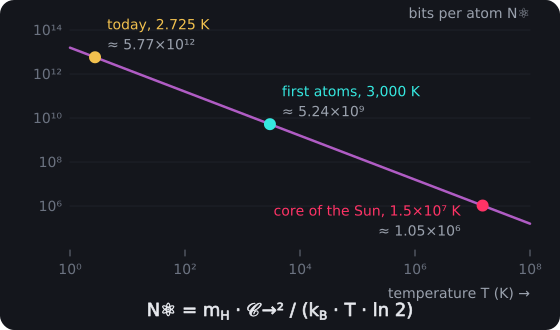
The Data in a Particle. One hydrogen atom's rest energy counted in bits, N⚛ = m_H · 𝒞→² / (k_B · T · ln 2): about 5.77 × 10¹² at today's 2.725 K, 5.24 × 10⁹ at 3,000 K when the first atoms formed, and 1.05 × 10⁶ in the core of the Sun. As the radiation cools, each particle is worth more data.
In the simulation each body of matter is data condensed at the Physical Nova, and the data of the field around it is the swarm it carries: the data falls in toward the matter and turns about it as the matter turns, so that every forming cluster of stars, and not only every well, is wrapped in its own spiral of data.
When Gas Becomes a Star
A clump of gas is held apart by the random motion of its particles, its temperature, and pulled together by its own gravity. When gravity wins it collapses. The threshold is the Jeans Mass (G) (Jeans, 1902): the mass above which a clump of given temperature and density cannot hold itself up. The same condition the book writes for a Null Well, a local intensity overwhelming what a region can sustain (Part 2.3), is written here for a clump of gas.
Star Formation Condition G
M_J = (π² · √π / 6) · σ³ / (G · √(G · ρ))
Dimensional analysis:
Where (from the book): M⊛ [𝕄], M_J [𝕄], σ [𝕃·𝕋⁻¹], G [𝕄⁻¹·𝕃³·𝕋⁻²], ρ [𝕄·𝕃⁻³]
[𝕄]
([∅] × √[∅] ÷ [∅]) × [𝕃³·𝕋⁻³] ÷ ([𝕄⁻¹·𝕃³·𝕋⁻²] × √([𝕄⁻¹·𝕃³·𝕋⁻²] × [𝕄·𝕃⁻³])) = ([∅] × [∅] ÷ [∅]) × [𝕃³·𝕋⁻³] ÷ ([𝕄⁻¹·𝕃³·𝕋⁻²] × √([𝕄⁻¹·𝕃³·𝕋⁻²] × [𝕄·𝕃⁻³])) = ([∅] ÷ [∅]) × [𝕃³·𝕋⁻³] ÷ ([𝕄⁻¹·𝕃³·𝕋⁻²] × √([𝕄⁻¹·𝕃³·𝕋⁻²] × [𝕄·𝕃⁻³])) = [∅] × [𝕃³·𝕋⁻³] ÷ ([𝕄⁻¹·𝕃³·𝕋⁻²] × √([𝕄⁻¹·𝕃³·𝕋⁻²] × [𝕄·𝕃⁻³])) = [𝕃³·𝕋⁻³] ÷ ([𝕄⁻¹·𝕃³·𝕋⁻²] × √([𝕄⁻¹·𝕃³·𝕋⁻²] × [𝕄·𝕃⁻³])) = [𝕃³·𝕋⁻³] ÷ ([𝕄⁻¹·𝕃³·𝕋⁻²] × √[𝕋⁻²]) = [𝕃³·𝕋⁻³] ÷ ([𝕄⁻¹·𝕃³·𝕋⁻²] × [𝕋⁻¹]) = [𝕃³·𝕋⁻³] ÷ [𝕄⁻¹·𝕃³·𝕋⁻³] = [𝕄]
[𝕄] = [𝕄] ✓ Valid PulseCore Verified ✓
A clump of mass M⊛ collapses toward a star when M⊛ ≥ M_J, the Jeans mass of its gas
Where:
- M⊛ [𝕄] — the mass of a clump of gas
- M_J [𝕄] — the Jeans mass: the most a clump of that gas can hold up against its own gravity
- σ [𝕃·𝕋⁻¹] — the speed of the gas's random motion (its sound speed, √(k_B·T/μ·m_H) for a gas at temperature T)
- G [𝕄⁻¹·𝕃³·𝕋⁻²] — the universe's gravitational coupling
- ρ [𝕄·𝕃⁻³] — the density of the gas
➢ Cold, dense gas has a small Jeans mass and fragments into small stars; warm, thin gas has a large one and forms nothing until it cools. In the dense cores of today's molecular clouds (about 10 K, 10⁴ – 10⁵ molecules a cubic centimetre) the Jeans mass is about half a Sun to a Sun, close to where the birth masses of stars peak, a few tenths of a Sun (Chabrier, 2003). A collapsing clump keeps fragmenting while it can still radiate its heat away; the smallest fragment it can make, the opacity limit, is about a hundredth of a Sun (Rees, 1976), which is why nothing much smaller than a brown dwarf forms the way a star does.
Why a Star Weighs What It Does
Gas temperature and density vary from cloud to cloud, yet stars everywhere weigh between about a tenth of a Sun and a hundred Suns. The reason is not in the gas but in the constants. A star is a ball of gas held up by its pressure, lit by fusion, and limited above by the pressure of its own light and below by the quantum pressure of its electrons; every one of those limits is a multiple of one mass built from the Planck mass and the mass of the hydrogen atom (Chandrasekhar, 1931; Eddington, 1926; Carr & Rees, 1979).
Stellar Mass Unit G
M⋆ = m_P³ / m_H²
Dimensional analysis:
Where (from the book): M⋆ [𝕄], m_P [𝕄], m_H [𝕄]
[𝕄]
[𝕄³] ÷ [𝕄²] = [𝕄]
[𝕄] = [𝕄] ✓ Valid PulseCore Verified ✓
The mass every star is sized by: the Planck mass cubed over the hydrogen mass squared
Where:
- M⋆ [𝕄] — the Stellar Mass Unit, ≈ 3.7 × 10³⁰ kg ≈ 1.85 M☉ in our universe
- m_P [𝕄] — the Planck mass, √(ħ·c/G) ≈ 2.18 × 10⁻⁸ kg: in this book, the mass of one Pulse at the level (Parts 2.2, 2.5)
- m_H [𝕄] — the mass of the hydrogen atom, ≈ 1.67 × 10⁻²⁷ kg: the first stable quantum of matter the Physical Nova makes
➢ Stars run from about 0.04 M⋆ (the hydrogen-burning limit) to about 50 M⋆, and the Chandrasekhar limit on a white dwarf is about 0.77 M⋆. So the Sun is not an accident of local conditions: it is a ratio of the Pulse to the matter quantum. This is where Binary Pulse Theory adds something no standard account has. Each universe takes its Planck values from the well it was born in (Part 2.5, Part 3.10: "its Planck values are set by the well it was born in"), so each universe has its own Stellar Mass Unit. The stars of a universe are sized by its lineage.
The Stars, by Their Birth Mass
Once a clump has collapsed, its mass decides everything that follows: how hot its surface is and so its colour, how bright it is, how long it lives, how it dies and what it leaves behind. The full sequence, as observation has established it, is below; the classes O, B, A, F, G, K and M run from the hottest to the coolest (Cannon & Pickering, 1918; Morgan, Keenan & Kellman, 1943), and the end states follow the masses of their cores (Woosley, Heger & Weaver, 2002; Heger et al., 2003). Masses are at birth, for gas like the Sun's unless marked.
| Birth mass (M☉) | Type | Surface (K) · colour | Lifetime | Death | Remnant |
|---|---|---|---|---|---|
| < 0.013 | Planetary-mass object | — | — | cools | none: a free-floating planet |
| 0.013 – 0.075 | Brown dwarf (L, T, Y) | 500 – 2,500 · deep red to infrared | no main sequence; burns deuterium briefly | cools for ever | a cooling brown dwarf |
| 0.075 – 0.5 | Red dwarf (M) | 2,400 – 3,900 · red | 10¹¹ – 10¹³ yr: none has died yet | fades, never a giant | helium white dwarf |
| 0.5 – 0.8 | Orange dwarf (K) | 3,900 – 5,300 · orange | 2×10¹⁰ – 6×10¹⁰ yr | red giant, planetary nebula | carbon–oxygen white dwarf |
| 0.8 – 1.2 | Yellow dwarf (G), the Sun | 5,300 – 6,000 · yellow-white | ≈ 10¹⁰ yr | red giant, helium flash, planetary nebula | carbon–oxygen white dwarf |
| 1.2 – 2 | F star | 6,000 – 7,500 · white | 2×10⁹ – 6×10⁹ yr | red giant, planetary nebula | carbon–oxygen white dwarf |
| 2 – 8 | A and late B stars | 7,500 – 15,000 · blue-white | 5×10⁷ – 2×10⁹ yr | asymptotic giant branch, planetary nebula | carbon–oxygen or oxygen–neon white dwarf, up to 1.4 M☉ |
| 8 – 25 | Massive B and O stars | 15,000 – 40,000 · blue | 10⁷ – 4×10⁷ yr | red supergiant, core-collapse supernova | neutron star, 1.2 – 2.3 M☉ (pulsar, magnetar) |
| 25 – 130 | Very massive O stars, Wolf–Rayet | 30,000 – 200,000 · blue to ultraviolet | 3×10⁶ – 7×10⁶ yr | supernova or failed supernova | Null Well: a Stellar Null Well, 5 – 50 M☉ |
| 130 – 250 (metal-poor) | Population III giants | ≈ 10⁵ · ultraviolet | ≈ 2×10⁶ yr | pair-instability supernova: the whole star blown apart | none |
| > 250 (metal-poor) | Population III giants | ≈ 10⁵ · ultraviolet | ≈ 2×10⁶ yr | direct collapse, no explosion | Null Well of 100 M☉ or more |
Main-Sequence Lifetime G
τ⊛ = τ☉ · (M/M☉)^(−2.5)
Dimensional analysis:
Where (from the book): τ⊛ [𝕋], τ☉ [𝕋], M [𝕄], M☉ [𝕄]
[𝕋]
[𝕋] × ([𝕄] ÷ [𝕄])^([∅]) = [𝕋] × ([𝕄] ÷ [𝕄])^([∅]) = [𝕋] × [∅]^([∅]) = [𝕋] × [∅] = [𝕋]
[𝕋] = [𝕋] ✓ Valid PulseCore Verified ✓
The heavier the star, the faster it burns: lifetime falls as mass to the −2.5
Where:
- τ⊛ [𝕋] — the time a star spends fusing hydrogen in its core, most of its life
- τ☉ [𝕋] — the Sun's, ≈ 10¹⁰ years
- M [𝕄] — the star's birth mass
- M☉ [𝕄] — the mass of the Sun, 1.989 × 10³⁰ kg
➢ A star's fuel grows with its mass but its brightness grows much faster, about as M^3.5, so the heaviest stars die first: by this law a 20 M☉ star lives about six million years (10¹⁰ × 20^(−2.5) ≈ 5.6 × 10⁶) and a 0.2 M☉ red dwarf about half a trillion (10¹⁰ × 0.2^(−2.5) ≈ 5.6 × 10¹¹); full stellar models give both ends longer lives, about ten million years and more than a trillion, as in the table above, because a single power law fits only the middle of the range (Kippenhahn, Weigert & Weiss, 2012; Adams & Laughlin, 1997). The consequence for a universe is an ordering in time. Its first deaths, and its first Stellar Null Wells, come within a few million years of its first stars; its white dwarfs accumulate for billions of years; its red dwarfs outlive everything else in it.
Initial Mass Function G
dN/dM = ξ₀ · (M/M☉)^(−α)
Dimensional analysis:
Where (from the book): dN/dM [𝕄⁻¹], ξ₀ [𝕄⁻¹], M [𝕄], M☉ [𝕄], α [∅]
[𝕄⁻¹]
[𝕄⁻¹] × ([𝕄] ÷ [𝕄])^([∅]) = [𝕄⁻¹] × ([𝕄] ÷ [𝕄])^([∅]) = [𝕄⁻¹] × [∅]^([∅]) = [𝕄⁻¹] × [∅] = [𝕄⁻¹]
[𝕄⁻¹] = [𝕄⁻¹] ✓ Valid PulseCore Verified ✓
How many stars are born at each mass: a few heavy ones, a great many light ones
Where:
- dN/dM [𝕄⁻¹] — the number of stars born per unit of birth mass
- ξ₀ [𝕄⁻¹] — the normalisation: how much gas the region turned into stars
- M [𝕄] — the birth mass
- M☉ [𝕄] — the mass of the Sun
- α [∅] — the slope: 2.35 above about 0.5 M☉ (Salpeter, 1955), 1.3 from 0.08 to 0.5 M☉ (Kroupa, 2001)
➢ Counted by number, about three stars in four are red dwarfs, about one in eight is Sun-like or heavier, and about one in six hundred is massive enough to end as a Null Well. Counted by mass, nearly half of the gas turned into stars sits in stars below a Sun. The steep slope is why Null Wells hold so little of a galaxy's matter, and why a sky is mostly faint red stars that the eye never sees.
How the Stars End
A star dies when its core runs out of fuel it can burn. What it leaves depends on what can still hold the core up. Electrons, squeezed together, resist with a quantum pressure; it holds up a core of up to about 1.4 Suns, the Chandrasekhar Limit (G), and that core is a white dwarf. Above it the electrons are pressed into the nuclei and neutrons resist instead, up to about 2.3 Suns, the Neutron Star Limit (G) (Tolman, 1939; Oppenheimer & Volkoff, 1939; observed maximum ≈ 2.1 – 2.3 M☉), and that core is a neutron star. Above that nothing known can resist: the core falls inside its own horizon and the Null Well Formation Condition (Part 2.3) is met by a star. The remnants and the events that make them are these:
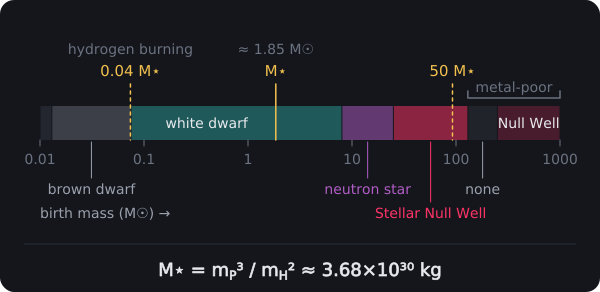
The Stellar Road to the Null Well. Birth mass decides the remnant: a white dwarf from 0.075 to 8 M☉, a neutron star from 8 to 25 M☉, a Stellar Null Well from 25 to 130 M☉; in metal-poor gas, nothing from 130 to 250 M☉ and direct collapse above. The scale is the Stellar Mass Unit M⋆ = m_P³ / m_H² ≈ 1.85 M☉: hydrogen burns from 0.04 M⋆, and stars reach about 50 M⋆.
| Remnant or event | Made by | Mass | What it does next |
|---|---|---|---|
| White dwarf | stars of 0.075 – 8 M☉ | up to 1.4 M☉ (Chandrasekhar) | cools to a black dwarf over 10¹⁵ yr; in a close binary it can take on mass |
| Type Ia supernova | a white dwarf pushed past 1.4 M☉ by a companion or a merger | ≈ 1.4 M☉ destroyed | nothing is left; a standard candle; iron enriches the gas |
| Neutron star · pulsar · magnetar | core collapse of 8 – 25 M☉ stars | 1.2 – 2.3 M☉ | spins down; in a binary it can merge |
| Kilonova | two neutron stars merging | 2.5 – 3 M☉ in, a Null Well or a heavy neutron star out | makes the heaviest elements (gold, platinum); a gravitational-wave event |
| Stellar Null Well (black hole) | cores above the neutron-star limit | 5 – 50 M☉ born; more by merging | accretes within its Eddington limit, merges, and evaporates by Hawking radiation when starved |
Stellar Null Well Condition G
r▣ = 2 · G · M▣ / c²
Dimensional analysis:
Where (from the book): M▣ [𝕄], M_TOV [𝕄], G [𝕄⁻¹·𝕃³·𝕋⁻²], c [𝕃·𝕋⁻¹]
[𝕃]
[∅] × [𝕄⁻¹·𝕃³·𝕋⁻²] × [𝕄] ÷ [𝕃²·𝕋⁻²] = [𝕄⁻¹·𝕃³·𝕋⁻²] × [𝕄] ÷ [𝕃²·𝕋⁻²] = [𝕃³·𝕋⁻²] ÷ [𝕃²·𝕋⁻²] = [𝕃]
[𝕃] = [𝕃] ✓ Valid PulseCore Verified ✓
A dead core with M▣ > M_TOV ≈ 2.3 M☉ collapses inside its own horizon r▣
Where:
- M▣ [𝕄] — the mass of the collapsed core when the star dies
- M_TOV [𝕄] — the neutron-star limit (Tolman–Oppenheimer–Volkoff)
- r▣ [𝕃] — the horizon of the Stellar Null Well (Part 2.4)
- G [𝕄⁻¹·𝕃³·𝕋⁻²] — the universe's gravitational coupling
- c [𝕃·𝕋⁻¹] — light speed, one Pulse Length a Tempo (ch 1)
➢ This is the same horizon, and the same Null Well, as every other in the book; only the road to it is different. A harmonic collapse makes a Null Well from overflowing data at a Nova; a star makes one from matter that has burned through its fuel. Stellar Null Wells are born small, 5 – 50 Suns, and late, a few million years after the first stars. They grow by accretion and by merging, and with nothing left to eat they evaporate (Part 3.10).
The Last Tenth: Giants, Pulsars and the Shells They Leave
A star does not end the moment its core hydrogen runs out. Through about nine tenths of its life it burns hydrogen in its core on the main sequence; in the last tenth it changes shape and colour (Iben, 1967; Kippenhahn, Weigert & Weiss, 2012). A star like the Sun swells into a red giant, a hundred times wider and far brighter, burns helium, and at the end blows off its outer layers as a glowing shell, a planetary nebula, lit for some ten thousand years by the hot core left behind, which cools as a white dwarf. A star of more than about eight Suns swells into a supergiant, blue and then red, as Betelgeuse is now, before its core collapses.
Giant Phase G
t⋆ᵍ = 0.1 · t⋆
Dimensional analysis:
Where (from the book): t⋆ᵍ [𝕋], t⋆ [𝕋]
[𝕋]
[∅] × [𝕋] = [𝕋]
[𝕋] = [𝕋] ✓ Valid PulseCore Verified ✓
The last tenth of a star's life is its giant phase
Where:
- t⋆ᵍ [𝕋] — the time a star spends as a giant or supergiant
- t⋆ [𝕋] — its main-sequence lifetime (Main-Sequence Lifetime, above)
➢ Hydrogen burning in the core sets the main sequence; the shell burning that follows is faster, about a tenth as long, across the whole range of masses (Kippenhahn, Weigert & Weiss, 2012).
A core that collapses to a neutron star keeps its spin, and turning a core thousands of kilometres across into a ball ten kilometres across spins it up as a skater pulling in her arms. Its magnetic field, squeezed with it, sweeps beams of radio light round the sky, and a neutron star seen from the path of a beam blinks: a pulsar (Hewish et al., 1968; Gold, 1968), turning from once every few seconds to hundreds of times a second. A few are born with fields a thousand times stronger still, magnetars, which flare (Duncan & Thompson, 1992). The supernova that made it leaves a remnant, a shell of gas and new metals expanding into the gas around, as the Crab Nebula has since the explosion seen in 1054.
Pulsar Spin G
P_ns = P_c · (R_ns / R_c)²
Dimensional analysis:
Where (from the book): P_ns [𝕋], P_c [𝕋], R_ns [𝕃], R_c [𝕃]
[𝕋]
[𝕋] × ([𝕃] ÷ [𝕃])² = [𝕋] × [∅]² = [𝕋] × [∅] = [𝕋]
[𝕋] = [𝕋] ✓ Valid PulseCore Verified ✓
A collapsing core keeps its spin and turns ever faster
Where:
- P_ns [𝕋] — the spin period of the new neutron star
- P_c [𝕋] — the spin period of the core before it collapsed
- R_ns [𝕃] — the neutron star's radius, about 10 km
- R_c [𝕃] — the core's radius before collapse
➢ Angular momentum, M·R²/P for a uniform ball, is kept, so the period falls as the square of the radius: a core turning once a day that shrinks a hundred thousand times turns in under a hundredth of a second. In Binary Pulse Theory the spin a pulsar keeps is the spin every clump gathers by tidal torque (Part 3.12), carried down to the smallest thing a star can leave; and the shells, planetary nebulae and remnants alike, are the star's matter, and the data it carries, returned to the gas for the next generation.
Generations and Feedback
The stars change the gas that makes the next stars. The first generation, Population III (G), formed from metal-free gas that could barely cool, so its stars were massive, tens to hundreds of Suns, short-lived, and the first source of heavy elements and of early Null Wells (Bromm & Larson, 2004). Their supernovae enriched the gas; the stars after them, Population II and then Population I like the Sun, are progressively richer in metals and smaller on average. Each supernova also drives a shock through the gas around it, compressing clouds past their Jeans mass and setting off new stars. Star formation is therefore self-regulating: stars heat and disperse the gas that would make more of them, and seed collapse in gas that would otherwise have stayed still.
Two of the end states are made by pairs. A white dwarf that takes on mass from a companion and crosses the Chandrasekhar limit explodes completely as a Type Ia supernova, leaving nothing, and is the standard candle by which the expansion of the universe was measured. Two neutron stars that spiral together make a kilonova, the forge of gold and platinum, observed in gravitational waves and light together in 2017 (Abbott et al., 2017).
The Census of Null Wells
The Null Well Progeny Count Law (Part 2.3) gives the number of Null Wells a universe forms in its life as N(L) = 2^(L/3), about 1.9 × 10²⁰ for our universe at level 202. Stellar Null Wells are the bulk of that census. Counting the Initial Mass Function and the end states above across the history of star formation gives about 4 × 10¹⁹ stellar-mass Null Wells in the observable universe today (Sicilia et al., 2022), within a factor of five of the law's count for the whole of a universe's life, of which the observable part and the present day are both only a share. The two numbers come from entirely different directions, one from the recursion of levels and one from the death of stars, and they agree in order of magnitude.
The Game's Reading
The simulation (the PulseCore game) runs universes far smaller than ours: at the energy its drawn field gives each bit (a level 6 field, or level 4 on a phone), about 10⁻⁵³ J, a single Sun would be about 10¹⁰⁰ bits of physical data, while the whole universe holds about 10⁷. It cannot weigh a real Sun, so it reads its stars by the same laws at its own scale. Its universes are small enough that one Pulse and one quantum of matter are both a single cell's worth, m_P = m_H, so its Stellar Mass Unit is one cell of matter and its Sun, by the Solar Mass of a Universe (Part 6.10), is 0.54 of a cell. The gas is the matter the Physical Nova condenses from the data. The game cannot see the dense cores where stars actually form, a cell being far coarser, so it forms them as every simulation of a universe does, by the observed law of how fast galaxies use their gas: where matter has gathered to more than twice the average density, its gas turns into stars over about 0.145 of the universe's life, faster where it is denser (the Gas Depletion Law, Part 6.10); the voids stay gas. Every star's type, colour, brightness, lifetime and end then follow its mass in those Suns, by the tables above, and only the heaviest leave a Stellar Null Well, which is born small, accretes, merges and evaporates.
2.9 Testable Predictions
- The census of Null Wells is dominated by Stellar Null Wells: the count of stellar-mass Null Wells, about 4 × 10¹⁹ in the observable universe today, should reach the Progeny Count Law's 2^(L/3) ≈ 1.9 × 10²⁰ over the whole of the universe's life
- Stellar masses scale with the Stellar Mass Unit m_P³/m_H²: a universe with different Planck values, inherited from a different well, has stars of a different size, and its whole stellar sequence shifts with them
- No Stellar Null Well is born between the neutron-star limit and about 5 M☉, nor between about 50 and 130 M☉ (the pair-instability gap): Null Wells found in the upper gap must be the products of mergers, not of single stars
- The first stars were massive and the first Null Wells came early: Null Wells of millions of Suns within the first billion years, as are now observed, are grown from Population III seeds by accretion and merging
- About one star in six hundred ends as a Stellar Null Well; the share falls as the gas grows richer in metals, generation by generation