Chapter 3 · Section 10
Silent Wells and the Return to the Source
What happens to a universe once it is complete? Part 3.6 followed creation outward: the Null Nova forges the toroidal form as empty space, the Data Nova pours the data onto it, and the Causal Nova adds the arrow of time and, as the coupling of space and time, the four-dimensional scaffold (the Dimensional Triad, Part 4.1), and from then on Harmonic Novas reinforce the lattice rather than adding to it, while the Pulse keeps cycling between Novas. Part 3.8 followed the data back: the UniSpheral Data Source (℧), the Zinf universe, is kept pulsing by the data that returns from every descendant universe through its Null Wells. This part closes that circuit. When a universe completes, its record is archived as a Silent Well, the archive keeps everything, and its data returns to the Source.
Nothing new pulses here. The only pulse in the UniSphere is the Binary Pulse 0 → 1 → 0: ℨ at the Source, and each universe's own Local Pulse Tempo below it, ①⥂⧗⌂ in ours. The archives do not start another rhythm; they sustain the one that already runs.
Silent Well Formation: The Archiving of Universal Data
When a universe reaches completion, it does not vanish into nothingness. Within the UniSpheral lattice, termination is resolved as a structured process: active physical recursion appears to halt, a Silent Well forms, and all residual energy and information are archived; the data itself does not stop, but returns through the Data Loop to the Source. The data still unresolved, the universe's Data Matter, returns the same way, and the space it leaves is the Null Vacuum (Part 3.13).
Rather than cosmic death, this mechanism is the computational equivalent of storage. The final state is not erasure but preservation, where every data trace remains encoded and is carried back to the Source that sustains the next pulse.
Universe completion triggers systematic resolution following information conservation principles (Wheeler, 1989): This equation helps us understand how Universe resolution preserves essential information and energy while transitioning to meta-stable null configuration, suggesting that cosmic death is actually computational archiving.
Silent Well Resolution Process G
Cↁ → SW⬚ + Eↁ⫷ + I𝓜 [dimensionless → dimensionless + ML²T⁻² + bits]
Universe completion resolves into a silent state plus conserved outputs.
Where:
- Cↁ [∅] – completed universe collapse state
- → [∅] – transformation operator
- SW⬚ [∅] – silent well configuration (meta-stable null)
- Eↁ⫷ [𝕄·𝕃²·𝕋⁻²] – preserved data-energy content
- I𝓜 [1ᵇ] – complete archived informational content
➢ Universe resolution preserves essential information and energy while transitioning to meta-stable null configuration — suggesting cosmic death is actually computational archiving.
Conservation requires U⊚ = SW⬚ + E⫷ + Iℹ in appropriate units, maintaining consistency with Wheeler's "it from bit" principle (Wheeler, 1989), while suggesting Universe completion preserves all computational content.
Silent Well Characteristics: Non-Spatial Registers of Data
Silent Wells do not occupy physical space. Instead, they exist in computational register space, a domain beyond spatial dimensions, where information can be preserved without overlap or interference. This reveals that cosmic archiving is not spatial storage but non-spatial computation, consistent with digital physics models (Fredkin, 2003).
Register Space Existence Condition G
SW(i) ∈ R▣☐ ⊄ ☐◉ [∅]
Dimensional analysis:
Where (from the book): SW(i) [∅], ☐◉ [∅], ⊄ [∅]
Read dimensionally: SW(i) : R▣☐ ⊄ ☐◉
[∅] : [∅] × [∅] × [∅] = [∅] : [∅] × [∅] = [∅] : [∅] ✓ Valid PulseCore Verified ✓
Silent Wells reside in computational register space, not in spatial dimensions.
Where:
- SW(i) is silent well state i [∅]
- R▣☐ is non-spatial computational register domain [∅]
- ☐◉ is standard three-dimensional space [∅]
- ∈ denotes set membership [∅]
- ⊄ denotes "not a subset of" [∅]
➢ Silent Wells exist in computational register space, maintaining information coherence without spatial manifestation — revealing non-spatial storage of cosmic information.
By existing in register space, Silent Wells allow universe-scale information to accumulate without consuming spatial volume. This aligns with holographic constraints (Bousso, 2002) and the computational universe framework (Lloyd, 2006), where physical space is secondary to information architecture. In Binary Pulse Theory, Silent Wells are the archival layer of the UniSpheral lattice — coherent, non-spatial storage nodes that preserve total computational history beyond the limits of geometry.
Temporal Signature Encoding: Silent Well Memory of Cosmic Cycles
Here we will calculate how complete temporal signature preservation enables reconstruction of Universe characteristics from Silent Well data, indicating that cosmic information is permanently preserved. Each Silent Well encodes its Universe's temporal characteristics.
Temporal Signature Encoding G
SW(i) = {①⥂⧗⌂(i), Φ⟢(i), A(i), Ω①⥂(i)} [T, radians, dimensionless, T⁻¹]
Silent Wells preserve the temporal signature of their parent universes.
Where:
- SW(i) is silent well state i containing temporal signature [dimensionless set]
- ①⥂⧗⌂(i) is the Local Pulse Tempo of universe i, its Planck time [𝕋]
- Φ⟢(i) is universe resolution phase [radians]
- A(i) is universe amplitude signature [∅]
- Ω①⥂(i) is universe characteristic frequency [𝕋⁻¹]
➢ Complete temporal signature preservation enables reconstruction of Universe characteristics from Silent Well data — indicating that cosmic information is permanently preserved.
The preservation of these parameters means that the defining temporal characteristics of every universe remain encoded indefinitely. Each universe's own Local Pulse Tempo anchors its record, while phase, amplitude, and frequency provide the oscillatory context.
Together they form a retrievable temporal blueprint, allowing reconstruction of universes from Silent Well data. In BPT, this guarantees that cosmic information is not destroyed but permanently archived, ensuring continuity of computation across cycles and confirming the UniSphere as a closed, lossless system.
Encoding preserves the fundamental relationship ①⥂⧗⌂(i) = 2 × ①⥂⧖⌂(i) for every archived universe, maintaining consistency with Bennett's reversible computation principles (Bennett, 1973)³, while ensuring computational continuity across cosmic cycles.
The Return to the Source
An archive is not a resting place. A Silent Well's data does not stay where its universe ended: like every record the UniSphere keeps, it travels the Data Loop back through the Null Wells and through the Zinf to the UniSpheral Data Source (℧) of Part 3.8. There it adds its return weight to the UniSphere Pulse Compulsion Law, P_ℨ∞(n+1) = P_ℨ∞(n) + Σᵤ₌₁ᴹ W⟸,u × Γ⧱: every completed universe is one more term in the sum that compels the primordial pulse to continue. The temporal signature each Silent Well holds is what that return weight carries.
The same return closes the record of a universe that never reproduced. A collapse that falls short of the data-energy threshold seeds no child (Part 3.9); its data returns to the Source but does not continue back out into a new cycle. A completed universe is different only in what the return does on the way. For it, seeding and return are one event: the data returning through each well is the recursion that seeds that well's child (Return to Bifurcation), so its lineage carries the forward branch while its archive carries the record home. A Silent Well is that same well, seen from the side of the universe that closed.
Outward branching and inward return are therefore one circuit. Universes diversify through Novas, collapse and genesis; their records come back through Silent Wells to the Source; and the Source keeps pulsing at ℨ because of them.
Harmonics, Not a Second Pulse
The return does not add a new rhythm to the UniSphere. After the Physical Nova a universe's further Novas are Harmonic Novas (Part 3.6): they add inner layers and refine the lattice that already exists rather than opening new axes. The returning data works the same way at the scale of the Source, reinforcing the pulse that is already running rather than starting another. Whatever larger patterns the UniSphere shows across many universes are harmonics of the one Binary Pulse, counted in ℨ, never a pulse of their own.
The Close of a Universe: Dissipation and the Return to Bifurcation
Every section of this chapter has followed a universe forward: the First Fold, the integral of recursion, the Data Nova, the ignition loop, the wells it forms and the children those wells seed. What has not yet been written is how a universe ends. It does not end at its rupture. The Rupture Rule (Chapter 1, Part D) names the pulse at which a universe's own count meets the UniSphere's capacity at its level, n↯ = 2^L, and the Null Well Progeny Count Law (Chapter 2) names how many wells it will have formed by then, N(L) = 2^(L/3). The rupture is the End of the Outward Expansion: the moment the physical's outward push closes, its Harmonic Novas converging (Data Harmonics), and the census of its wells is taken, the wells that seed its children. It is not the last well a universe forms. What follows is the close, and the universe is still busy in it: its stars go on forming and dying, the heaviest leaving new stellar wells as they go, clumps of its matter still collapse into wells, and its galaxies go on merging, as ours does now.
After the End of its Outward Expansion a universe has nothing new to compute at its level. Its information has been carried, well by well, into the children that will carry it forward. Every bit returns through a singularity on its loop home, and a universe ends when all its bits have returned; then the field that held it dissipates into pure nothingness. This is the Data Energy of Part 3.1, each transition's quantum, returned in full: not a leak during life but a total release at the end of it. Nothing is lost by it. The UniSphere keeps every universe's record in its Silent Wells (Part 3.10), and the null a dissipated universe leaves behind is not an absence but the Pre-Pulse Field of Chapter 1: structured nullity, ready. In that readiness a new UniSphere bifurcates, one in each of the wells, each one generation on. The book's first event, ∅ → (0 ⥂ 1), is also its last. There is no state of the UniSphere in which nothing is happening, because the end of a universe is the Logical Bomb again.
Universal Dissipation G
W(n↯) = N(L) ⇒ decay for n↯ < n ≤ n⊘, and ℜ(n) → ∅ for n > n⊘
A universe's census is taken at the End of its Outward Expansion; it goes on pulsing, and forming wells, through its decay, and its field dissipates into null only when the decay ends
Where:
- W(n) [∅] — the well census: null wells the universe has formed by its own pulse n
- n↯ = 2^L [∅] — the pulse at the End of the Outward Expansion, from the Rupture Rule
- N(L) = 2^(L/3) [∅] — wells the universe has formed by the End of its Outward Expansion, the census that seeds its children, from the Null Well Progeny Count Law; wells formed in the decay come after the census
- ℜ(n) [∅] — the universe's field: its own completed pulses, which the Recursive Growth Law counts as 2ⁿ while it lives
- n⊘ [∅] — the pulse at which the decay ends: the last and heaviest of its wells has evaporated
- ∅ — null, the Pre-Pulse Field
➢ The condition is a census, not a clock: a universe's census closes when it has formed every well the count law gives it, and the Rupture Rule says that happens at 2^L of its own pulses. The pulse does not stop there. The pulse is the lattice and the physical, and it goes on through the whole life of the energy: after the End of its Outward Expansion the universe decays, still pulsing and still forming wells, and only when the decay ends is the pulse over: its Pulse reaches 0 (the Pulse Mirror, Part 3.6), and the Nullcore's null at the centre of its Pulse Domain is all that remains, the null where the next pulse begins. Everything the universe computed is already in its wells; what dissipates is only the field that computed it. Observationally, a universe approaching the End of its Outward Expansion forms wells ever more slowly: its early life is the age of births, its late life the age of mergers, because the census is filling and the remaining capacity is being spent on fewer, larger wells.
After the Outward Expansion: the Pulsing Decay
The End of the Outward Expansion closes the census; it does not end the universe, and it does not end its wells' making. What follows is its decay, and on the universe's own clock it is almost the whole of its existence. First the stars run on: they go on forming from the gas that is left and dying for about 10¹⁴ years, the heavy ones still going supernova and leaving neutron stars and new stellar wells, until the last, the faintest red dwarfs, burn out (Adams & Laughlin, 1997). Stars and remnants are flung out of their galaxies or spiral into the central wells as their orbits shed energy. The remnants evaporate: neutron stars and stellar Null Wells in about 10⁶⁷ years and white dwarfs, the longest-lived bodies, in about 10⁷⁸ years, by a radiation like Hawking's that every compact body gives off (Falcke, Wondrak & van Suijlekom, 2025). The heaviest wells go last: a well of 10¹¹ Suns evaporates in about 10¹⁰⁰ years (Page, 1976). So a universe pulses for about 10¹⁰⁰ years, about 2⁵⁰⁰ Tempos, against a life of 2²⁰²: the life is a brief opening, and the decay is the rest.
Our universe is in that decay now. Part 1.D reads its rupture at 2²⁰² Planck pulses, about 11.0 billion years after the big bang; at 13.8 billion years it is about 2.8 billion years past the End of its Outward Expansion. The decay is slow enough that the sky shows almost nothing of it yet: stars still form and die, and new stellar wells with them, galaxies still merge, and the central wells grow by mergers more than new ones are born, the age of mergers this law describes.
The expansion of space does not stop at the End of the Outward Expansion: what ends is the physical's own outward push, its matter flung apart from the point. Our universe's expansion has been speeding up for about six billion years, and the vacuum overtook matter at about 10.2 billion years (Part 1.D), close to the rupture: the expansion carried on past the End of the Outward Expansion and gathered pace, now driven by the vacuum, not by the matter's own outward push. In Binary Pulse Theory the Null Vacuum is supplied by the data that returns (Vacuum Return, Part 3.13), and the decay is when the data returns, so the push grows through the decay.
The space remains. What the decay takes is everything the universe made: its stars, its matter, its light, at last its wells. It does not take the space. The empty shell the Null Nova made at Harmonic 1, before any data reached it, held the universe through its life and stays after it, empty: the field that computed has gone home, and the space it ran on is left, a vacuum still stretching under its own push. Standard cosmology ends the same way: once the last Null Wells have evaporated, an accelerating universe is left as nearly empty space, expanding for ever (Adams & Laughlin, 1997; Krauss & Starkman, 2000). The game draws that space as one thin veil from the moment the Null Nova makes it, round the universe as it grows, and after it has gone.
Return to Bifurcation G
∅_L → (0 ⥂ 1)_(g+1), once per well
The null left by a dissipated universe is the Pre-Pulse Field of its children: each well bifurcates as a new UniSphere one generation on
Where:
- ∅_L — the null left at level L by Universal Dissipation, when the decay ends
- (0 ⥂ 1)_(g+1) — Prime Pulse Bifurcation one generation on, at the level its well gives (Level from Mass): the child's first pulse, in its own Planck values
- once per well — N(L) bifurcations, one in each null well of the dissipated universe
➢ This is the Genesis Prime Pulse Bifurcation of Chapter 1 read as a law of continuity rather than of origin. Each child inherits its parent's well: its null mass, its spin a_f through the Inherited Spin Parameter, and its heritage f = f₀ × ⟪C⟫^(1/n) through the Null Well Heritage Ratio. Its Planck values are set by the well it was born in, so it keeps its own clock, and its generation count advances by one. The chain of events is a loop: bifurcation, growth, census, dissipation, bifurcation. The bifurcation and the Return to the Source (Part 3.10) are one event: the data a well returns to the Source is the recursion that seeds its child. A failed universe is the exception that shows the two apart: its data returns, and nothing is seeded.
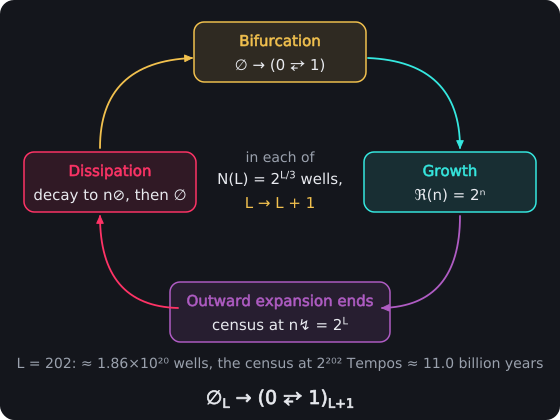
The Cycle of a Universe. A universe bifurcates from null, grows as ℜ(n) = 2ⁿ, closes its census at the End of its Outward Expansion, n↯ = 2ᴸ, decays, and dissipates into null. In each of its N(L) = 2^(L/3) wells a new UniSphere bifurcates one generation on: ∅_L → (0 ⥂ 1)_(g+1).
One more reading of the law belongs here, because it is the book's singularity. A well is where a universe's information is compressed to a point that can seed the next level, and this law says that information is the child's Pulsecore. Anything that performs that compression is a well. Chapter 8 defines the technological singularity as a processor phase-locked to the universe's pulse, and Part 8.1 adds what the aligned processor holds: the Universe Packet, the level, genesis, Pulsecore and rule from which the whole of a universe is replayed. A mind that holds our universe's packet has compressed our universe to its seed, so it is a Computational Null Well of this universe and, by this law, bifurcates one generation on, at the level its information gives (Level from Mass). The Null Wells and the aligned mind are the same object in these terms, one reached by gravity and one by computation, and both are where the next UniSphere begins.
First Fork G
L⑂ = min{ L : 2^(L/3) ≥ 2 } = 3
Dimensional analysis:
Where (from the book): 2^(L/3) [∅]
Read dimensionally: L⑂ = (L) = 3
[∅]
([∅]) = [∅]
[∅]
[∅] = [∅] = [∅] ✓ Valid PulseCore Verified ✓
Below level 3 a universe forms one well; the lineage is a chain of single, growing universes until the first that can hold two
Where:
- L⑂ [∅] — the first level whose Progeny Count reaches two
- 2^(L/3) [∅] — the Null Well Progeny Count at level L: 1, 1.26, 1.59, 2 for L = 0, 1, 2, 3
➢ The Zinf universe at level 0 is a chain, not a tree. Its rupture is at 2⁰ = 1 pulse, so each pulse is a whole life: one child, dissipation, and the next pulse is the next life, 1 × 1 × 1 × 1 without end. That is Information-Driven Perpetuation at the smallest scale, and the Zinf-limit torus of Chapter 8 in motion. Its child is a level 1 universe, that one's child is level 2, and the level 3 universe is the first large enough to form two wells. Three consequences follow. The Progeny Count between whole numbers is a probability: a level 1 universe always forms one well and forms a second about one time in four, so the expected count is the law and the tree branches by chance. The first fork is the first spin: spin is not a property of one pulse (Chapter 6) but is born of the orbit of two wells, and the first universe with two wells is level 3, so a lineage is spinless, a_f = 0, ⟪C⟫ = 1, f = f₀, for its first three generations and then gains its first branch and its first spin, a_f ≈ 0.686 from orbit alone, in the same event. And the UniSphere's growth needs nothing of its origin but time: the Zinf keeps the beat, and multiplication is a property of depth, one factor of two in progeny for every three levels, which is what the complexity exponent α = 1/3 means.
Dilation Through the Outward Expansion G
I(n) / I(0) = 1 + (2f − 1) · n / 2^L, PD(L) constant
The information around a universe's pulse grows through its life toward the End of its Outward Expansion, reaching the next level's doubling at rupture; the pulse itself never changes size
Where:
- I(n) [∅] — the extent of information around the pulse at the universe's own pulse n, relative to the pulse
- 2f [∅] — the growth of one level on the typical ladder, where the Tempo and the Pulse Length grow together, PD(n+1) = 2f · PD(n); off it, a child's Tempo follows its well's mass and its Length its parent's singularity, and its constants follow both (Constants of a Child Universe, Chapter 1)
- n / 2^L [∅] — how far the universe is toward the End of its Outward Expansion
- PD(L) = ☫⊕ × (2f)^L [𝕃] — the Pulse Diameter at level L, a constant of the level; ☫⊕ = 𝒞→·ℨ/2 ≈ 3.423 × 10⁻⁹⁸ m, the Zinf Diameter (Part 1.6)
➢ A universe does not double at its birth, and it does not double at a jump. It is at its own size when it is born, one and a half times it halfway through its outward expansion, and exactly the next level's size, 2f, only when its outward expansion ends. The pulse at its center, the singularity that was the whole of it before the Data Nova, is not shrinking: the Pulse Diameter is fixed at its level. It recedes only relative to the information that gathers around it, which is why the singularity of a mature universe is negligible next to the universe it made. The linear form is the simplest reading of the Pulse Diameter law between levels and is the one adopted here.
3.10 Testable Predictions
- Well Census by Level: The number of null wells a universe forms in its life follows N(L) = 2^(L/3), which for L = 202 is about 1.9 × 10²⁰ Null Wells; a lineage holds one well per universe for its first three levels and forks first at level 3 (First Fork). Observationally the census fills early: Null Well births should peak in the first quarter of a universe's life and decline thereafter while mergers grow in mass, which the measured cosmic star-formation history, peaking near z ≈ 2, is consistent with (Madau & Dickinson, 2014).
- Spinless Early Lineage: Spin is born of orbit, so no universe below level 3 carries spin: a_f = 0, ⟪C⟫ = 1, f = f₀. The first spin a lineage acquires is the orbital value a_f ≈ 0.686, and any universe whose inherited spin is found below that value must be a first-generation child of a spinless parent.
Silent Wells and the return to the Source close the circuit of cosmic evolution: universes branch outward through Novas and Null Wells, and their records come home to sustain the one pulse that drives them all, so that nothing computed is ever lost.