Chapter 3 · Section 11
The Expansion of the Physical Universe
What does the Physical Nova, the Causal Nova of Part 3.6, look like from inside the universe it makes? Exactly as cosmology has measured it. The torus implodes to the point, the Pulsecore's own size (Part 3.6), and then everything erupts outward at once: not matter flying out from a point into a space that was waiting for it, but space itself growing, everywhere at once, with all of its matter in it. Every grain is carried away from every other; no place in the universe is its centre. This part writes that expansion in the laws observation has confirmed since Hubble (1929), and shows where each meets Binary Pulse Theory: the start of the expansion is the point, the gravity of the universe is set by its density and its life, and the expansion fills the reach the Dilation law gives the information of its level.
Friedmann Equation G
H² = 8 · π · G · ρ / 3
Dimensional analysis:
Where (from the book): H [𝕋⁻¹], G [𝕄⁻¹·𝕃³·𝕋⁻²], ρ [𝕄·𝕃⁻³]
[𝕋⁻²]
[∅] × [∅] × [𝕄⁻¹·𝕃³·𝕋⁻²] × [𝕄·𝕃⁻³] ÷ [∅] = [∅] × [𝕄⁻¹·𝕃³·𝕋⁻²] × [𝕄·𝕃⁻³] ÷ [∅] = [𝕄⁻¹·𝕃³·𝕋⁻²] × [𝕄·𝕃⁻³] ÷ [∅] = [𝕋⁻²] ÷ [∅] = [𝕋⁻²]
[𝕋⁻²] = [𝕋⁻²] ✓ Valid PulseCore Verified ✓
How fast space expands is set by how much matter is in it
Where:
- H [𝕋⁻¹] — the Hubble rate, ȧ/a, how fast the universe is growing
- G [𝕄⁻¹·𝕃³·𝕋⁻²] — the universe's gravitational coupling
- ρ [𝕄·𝕃⁻³] — the density of the matter
➢ Friedmann (1922) derived it from general relativity; it is written here for a flat universe dominated by matter, which ours was from about fifty thousand years after the big bang until a few billion years ago. Gravity and expansion are not two separate things: the expansion rate at any moment is fixed by the density at that moment.
Hubble Law G
v = H · d
Dimensional analysis:
Where (from the book): v [𝕃·𝕋⁻¹], H [𝕋⁻¹], d [𝕃]
[𝕃·𝕋⁻¹]
[𝕋⁻¹] × [𝕃] = [𝕃·𝕋⁻¹]
[𝕃·𝕋⁻¹] = [𝕃·𝕋⁻¹] ✓ Valid PulseCore Verified ✓
Everything recedes from everything else at a speed proportional to its distance
Where:
- v [𝕃·𝕋⁻¹] — the speed at which a distant region recedes
- H [𝕋⁻¹] — the Hubble rate
- d [𝕃] — its distance
➢ Measured by Hubble (1929) and anticipated by Lemaître (1927). It is the signature of space expanding rather than of matter exploding into it: every observer, anywhere, sees the same law with themselves at the centre.
Matter-Era Expansion G
a = (t / t⊚)^(2/3)
Dimensional analysis:
Where (from the book): a [∅], t [𝕋], t⊚ [𝕋]
[∅]
([𝕋] ÷ [𝕋])^([∅] ÷ [∅]) = ([𝕋] ÷ [𝕋])^([∅]) = [∅]^([∅]) = [∅]
[∅] = [∅] ✓ Valid PulseCore Verified ✓
A universe of matter grows as time to the two-thirds: fast at first, then slowing
Where:
- a [∅] — the scale factor: the size of the universe relative to its size at time t⊚
- t [𝕋] — the time since the Physical Nova
- t⊚ [𝕋] — the reference time, at which a = 1
➢ The Einstein–de Sitter solution of the Friedmann Equation (Einstein & de Sitter, 1932). Its Hubble rate is H = 2/(3t), so the universe grows quickly just after its Physical Nova and ever more slowly after; half its final size is reached a third of the way through its matter era.
Matter Dilution G
ρ = ρ⊚ · a^(−3)
Dimensional analysis:
Where (from the book): ρ [𝕄·𝕃⁻³], ρ⊚ [𝕄·𝕃⁻³], a [∅]
[𝕄·𝕃⁻³]
[𝕄·𝕃⁻³] × [∅]^([∅]) = [𝕄·𝕃⁻³] × [∅]^([∅]) = [𝕄·𝕃⁻³] × [∅] = [𝕄·𝕃⁻³]
[𝕄·𝕃⁻³] = [𝕄·𝕃⁻³] ✓ Valid PulseCore Verified ✓
As space grows, the same matter fills more of it
Where:
- ρ [𝕄·𝕃⁻³] — the density of matter at scale factor a
- ρ⊚ [𝕄·𝕃⁻³] — its density when a = 1
- a [∅] — the scale factor
➢ Matter is neither made nor lost by the expansion; it is spread. The early universe is the same matter as the late one, packed into a smaller space: dense, hot, and pulling hard on itself.
Hubble Drag G
v⇝ = v⇝⊚ · a⊚ / a
Dimensional analysis:
Where (from the book): v⇝ [𝕃·𝕋⁻¹], v⇝⊚ [𝕃·𝕋⁻¹], a⊚ [∅], a [∅]
[𝕃·𝕋⁻¹]
[𝕃·𝕋⁻¹] × [∅] ÷ [∅] = [𝕃·𝕋⁻¹] ÷ [∅] = [𝕃·𝕋⁻¹]
[𝕃·𝕋⁻¹] = [𝕃·𝕋⁻¹] ✓ Valid PulseCore Verified ✓
Motion through space dies away as space grows
Where:
- v⇝ [𝕃·𝕋⁻¹] — a body's peculiar velocity, its motion through space on top of the expansion
- v⇝⊚ [𝕃·𝕋⁻¹] — its peculiar velocity when the scale factor was a⊚
- a⊚ [∅] — that earlier scale factor
- a [∅] — the scale factor now
➢ A body's momentum through space falls as 1/a. This is why the expansion calms the motions of the early universe, and why bound systems, which do not take part in the expansion, keep their fast internal motions while the space between them quiets.
Linear Growth of Structure G
δ = δ⊚ · a / a⊚
Dimensional analysis:
Where (from the book): δ [∅], δ⊚ [∅], a [∅], a⊚ [∅]
[∅]
[∅] × [∅] ÷ [∅] = [∅] ÷ [∅] = [∅]
[∅] = [∅] ✓ Valid PulseCore Verified ✓
Small excesses of matter grow in step with the universe
Where:
- δ [∅] — the density contrast of a region, (ρ − ρ̄)/ρ̄
- δ⊚ [∅] — its contrast when the scale factor was a⊚
- a [∅] — the scale factor
- a⊚ [∅] — that earlier scale factor
➢ In a matter universe a small overdensity grows in proportion to the scale factor (Peebles, 1980), until it reaches about one and collapses into a bound structure: a cloud, a cluster of stars, a galaxy. Structure is not imposed on the expanding universe; it grows out of the slight unevenness the universe was born with, while it expands.
The First Ripples
Structure grows from the slight unevenness a universe is born with; the question is how that unevenness is laid down. Zel'dovich (1970) gave the answer cosmology still uses to begin every simulation of the universe: the matter starts almost perfectly even, each piece at its own place on a regular grid, and each is moved a little, and set moving, along the gradient of the ripples in the density it came from. Where the ripples converge the matter piles first into sheets, the sheets meet in filaments, and the filaments cross in clusters: the cosmic web, with empty voids between.
Zel'dovich Displacement G
x = q + D · ψ
Dimensional analysis:
Where (from the book): x [𝕃], q [𝕃], D [∅], ψ [𝕃]
[𝕃]
[𝕃] + [∅] × [𝕃] = [𝕃] + [𝕃] = [𝕃]
[𝕃] = [𝕃] ✓ Valid PulseCore Verified ✓
Each piece of matter starts at its own place and is moved along the ripples, more as the universe grows
Where:
- x [𝕃] — where a piece of matter is
- q [𝕃] — its place on the even grid it began on
- D [∅] — the growth of the ripples, D = a in a matter universe (Linear Growth of Structure)
- ψ [𝕃] — the displacement field: the gradient of the ripples, pointing toward where the density is higher
➢ The density contrast the displacement makes is δ = −D·∇·ψ: matter is drawn out of the troughs of the ripples and into their crests. The approximation holds until the paths of neighbouring pieces cross; from then on the full gravity of the matter takes over, and the crossings are the sheets and filaments themselves.
Growing-Mode Velocity G
u = D · H · ψ
Dimensional analysis:
Where (from the book): u [𝕃·𝕋⁻¹], D [∅], H [𝕋⁻¹], ψ [𝕃]
[𝕃·𝕋⁻¹]
[∅] × [𝕋⁻¹] × [𝕃] = [𝕋⁻¹] × [𝕃] = [𝕃·𝕋⁻¹]
[𝕃·𝕋⁻¹] = [𝕃·𝕋⁻¹] ✓ Valid PulseCore Verified ✓
Each piece moves with the ripples' growth from the start
Where:
- u [𝕃·𝕋⁻¹] — the velocity of a piece of matter through space at the start
- D [∅] — the growth of the ripples
- H [𝕋⁻¹] — the Hubble rate, 2/(3t) in a matter universe
- ψ [𝕃] — the displacement field
➢ Set moving this way, every ripple is in its growing mode from the first instant, so it grows in step with the expansion and none of it decays away. Started at rest instead, half of every ripple would be lost.
In Binary Pulse Theory the ripples are not put in by hand: they are the data. From the Data Nova the data has filled the scaffold (Part 3.6), and at the Causal Nova the physical is condensed from it where it lies; the ripples are the unevenness of that data on the lattice, densest along its lines and densest of all at its nodes. So the web that grows from them is laid out by the scaffold: its filaments follow the lattice's lines and its clusters gather at the lattice's nodes, as the visible web of our universe follows the dark matter beneath it.
The simulation begins its matter this way. One body for each quantum of matter, as many as the device that draws it can hold (every quantum, about 19,000, at level 5), is laid on an even grid; the ripples are a third the data on the scaffold and two thirds the random field of Part 3.12, smoothed over two cells, on a grid jittered within each cell; each body is displaced by D·ψ and moves at D·H·ψ. The ripples are scaled so that, grown linearly, their spread would reach about three by the End of the Outward Expansion, so that the web is fully formed by the end of a life, as ours is today. They are the scaffold's own pattern, smoothed over two cells; ripples longer than a quarter of the universe are left out, since our universe is smooth on its largest scales (read as one ripple the size of the universe, the uneven spread of the data across the tube carried all the matter one way). Those three sizes are the simulation's choices here. Every cell of the simulation covers the same area of the universe: on the horn torus a band of the tube covers area in proportion to its distance from the axis, R + r·cos v, so the field is drawn on it by an equal-area map, row fraction s at the angle where R·v + r·sin v is the fraction s of 2πR, and gravity on the flat grid of cells is then exact on the surface it is drawn on. Gravity, in step with the expansion, does the rest.
Where the Expansion Meets the Pulse
Point Scale G
a↯ = R⊛ / R⊚
Dimensional analysis:
Where (from the book): a↯ [∅], R⊛ [𝕃], R⊚ [𝕃]
[∅]
[𝕃] ÷ [𝕃] = [∅]
[∅] = [∅] ✓ Valid PulseCore Verified ✓
At the Physical Nova the universe is the size of its Pulsecore
Where:
- a↯ [∅] — the scale factor at the Physical Nova
- R⊛ [𝕃] — the radius of the Pulsecore, one Pulse Diameter across at its level (ch 1)
- R⊚ [𝕃] — the radius of the universe when it reaches the End of its Outward Expansion
➢ The expansion begins from the point, so its starting size is the Pulsecore's. In our universe that is a Planck length against the reach of the observable universe, a↯ ≈ 10⁻⁶¹: the big bang as observed, from a point no larger than a Pulse. This is the same statement, read in the scale factor, as Part 3.10's "the singularity of a mature universe is negligible next to the universe it made."
Gravity of a Universe G
G = 1 / (6 · π · ρ̄ · T²)
Dimensional analysis:
Where (from the book): G [𝕄⁻¹·𝕃³·𝕋⁻²], ρ̄ [𝕄·𝕃⁻³], T [𝕋]
[𝕄⁻¹·𝕃³·𝕋⁻²]
[∅] ÷ ([∅] × [∅] × [𝕄·𝕃⁻³] × [𝕋²]) = [∅] ÷ ([∅] × [𝕄·𝕃⁻³] × [𝕋²]) = [∅] ÷ ([𝕄·𝕃⁻³] × [𝕋²]) = [∅] ÷ [𝕄·𝕃⁻³·𝕋²] = [𝕄⁻¹·𝕃³·𝕋⁻²]
[𝕄⁻¹·𝕃³·𝕋⁻²] = [𝕄⁻¹·𝕃³·𝕋⁻²] ✓ Valid PulseCore Verified ✓
A matter universe's gravity is fixed by its density and its age
Where:
- G [𝕄⁻¹·𝕃³·𝕋⁻²] — the universe's gravitational coupling
- ρ̄ [𝕄·𝕃⁻³] — its mean matter density at the End of the Outward Expansion
- T [𝕋] — its age at the End of its Outward Expansion: the time from the Physical Nova
➢ Set H = 2/(3T) in the Friedmann Equation and solve for G. In this book the age is not free: the Rupture Rule gives each universe its life, 2^L of its own Tempos (ch 1, Part D), so a universe's gravity, its density and its level are bound together. Of two universes with the same density, the deeper one, living longer, has the weaker gravity; the stronger gravity belongs to the short lives of the shallow levels.
The expansion and the Dilation Through the Outward Expansion (Part 3.10) describe two things and do not compete. The Dilation law gives how far the information around a universe's Pulse reaches by the End of its Outward Expansion, 2f times its birth extent; it is a law of the level. The expansion gives how the physical universe fills that reach after its Physical Nova: by the Matter-Era Expansion, from the point to full size. The information grows steadily with the universe's own pulses; the physical grows fast at first and then slows, as every matter universe must.
The First Light and the First Waves
The Physical Nova fills its universe with light. The Null Nova made the space, the empty shell of Harmonic 1; the scaffold and all its data drew in to the point; and the physical universe erupts from it, every part of it at once, and grows to fill that shell over its life. Its first light fills all of it from the first instant, with no centre and no edge, as the light of our big bang does: the microwave background reaches us from every direction alike. The light does not cross the shell as a front: a front would leave an edge in every sky, galaxies running on to the horizon one way and stopping the other, and our sky has none. The light is carried with the space instead, and stretched with it, so it cools:
Radiation Cooling G
T_γ = T_γr · aᵣ / a
Dimensional analysis:
Where (from the book): T_γ [Θ], T_γr [Θ], a [∅], aᵣ [∅]
[Θ]
[Θ] × [∅] ÷ [∅] = [Θ] ÷ [∅] = [Θ]
[Θ] = [Θ] ✓ Valid PulseCore Verified ✓
The first light cools as the space that holds it grows
Where:
- T_γ [Θ] — the temperature of the first light now
- T_γr [Θ] — its temperature when it was released
- a [∅] — the scale factor now
- aᵣ [∅] — the scale factor at its release
➢ Ours was released at about 3,000 K, when the plasma cooled enough to let it go, some 380,000 years in, and has been stretched about 1,100 times since: 2.7255 K today (Fixsen, 2009), the microwave background.
The glow does not last. Light at 3,000 K is white-hot; by the time space has grown two and a half times it is cherry red, about 1,200 K, and after that no eye would see it: the whole sky goes dark, and stays dark through the dark ages (Part 3.12), the gas cooling faster than the light, until the first stars light it again (Part 2.9) and reionize it (Part 3.12). So a universe's first act after its big bang is a flash that fades to black, and then a darkness in which its matter gathers unseen along the scaffold; the game draws it so.
The eruption shakes spacetime too. The first instants leave a background of gravitational waves, raised from the vacuum as space grows (Grishchuk, 1975; Starobinsky, 1979), and they fill the universe as its light does, everywhere at once, and stretch with it:
Primordial Wave Stretch G
λ_w = λ_w0 · a / a₀
A primordial gravitational wave grows with the space it crosses
Where:
- λ_w [𝕃] — the wave's length now
- λ_w0 [𝕃] — its length when it was raised
- a [∅] — the scale factor now
- a₀ [∅] — the scale factor when it was raised
➢ The same stretch as the light's; inside the horizon the strain also falls as a₀/a. This background has not yet been seen: the polarisation of the microwave background bounds it below 3.6 % of the first ripples' strength, r < 0.036 (BICEP/Keck Collaboration, 2021), and the background found by timing pulsars, at nanohertz, is most likely the sum of pairs of supermassive wells instead (Agazie et al., 2023). Chapter 9 predicts its spectrum carries the Pulse's harmonics.
The shape of the space shows in the first light. A space that closes on itself cannot hold waves longer than itself, and holds its longest along its own axes. A torus just larger than the horizon so weakens the largest patterns of the microwave sky and lines them up with its axes. Our sky shows both: its largest pattern, the quadrupole, is weaker than the theory of the ripples expects, and lined up with the next, the octupole, along one axis (de Oliveira-Costa et al., 2004; Land & Magueijo, 2005), seen again by Planck, if not yet beyond chance (Planck Collaboration, 2020). Our horn torus stands just past the bound the matched circles set (Part 3.5), where that is what it should do.
The game draws the first light at the Physical Nova as a white-hot glow over the whole torus, cooling through yellow and red to dark as it grows, with the first waves' crests over it, stretching with the space; the empty shell of Harmonic 1 stays in view round it, darker than the sky, as the space it grows to fill, the rings of the Harmonic Novas from Harmonic 4 laid outside it; space holds a floor of starlight, a void a tenth or more of the mean (Sheth & van de Weygaert, 2004); and each later merger sends out its own rings from its own place.
The Game's Reading
The simulation runs the expansion as written, with the Null Vacuum's push of Part 3.13 added. From the Physical Nova the torus grows by a ∝ sinh^(2/3)(x), x = K · (t + t₀) / T_life, the flat law of matter and vacuum together: the matter era's (t + t₀)^(2/3) early and a gentle speed-up late, from the point (t₀ puts a at the Pulsecore's size at t = 0) past its size at the End of the Outward Expansion and on through the decay, faster as the vacuum's share grows, since the expansion does not stop at the End of the Outward Expansion. Its clock is the universe's own, 2^L Tempos from the Physical Nova, the Pulsecore and the first two Novas taking none of it. By the Level Λ Law every universe's vacuum, measured in its own life of 2^L Pulses, has the same strength, Λc²T_life² = 3π / (16 ln 2), so K = (3/2)·√(π / (16 ln 2)) ≈ 0.80 at every level, and the vacuum's share of the universe, tanh²(x), reaches about 0.44 at the End of the Outward Expansion and goes on rising through the decay, 0.58 at 13.8 billion years by the law's Λ and 0.69 by the measured one; the surface of the torus darkens behind the stars as it grows. Its matter, and the Data Matter that outweighs it 27 to 5, move in comoving cells, so the expansion appears as Hubble Drag on the bodies' motions (as 1/a²) and as gravity across the grid falling as a⁻³; its G is the Gravity of a Universe from the mean density of both together and T. The dust begins packed into the point with all of it present, and the torus balloons out with it, the clumps and filaments growing as it does, the stars igniting in them.
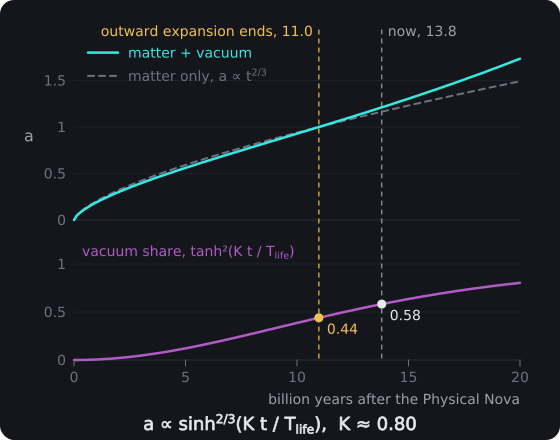
The Expansion with the Null Vacuum. With matter and vacuum together the scale factor grows as a ∝ sinh^(2/3)(K t / T_life), K ≈ 0.80, here set to 1 at the End of the Outward Expansion, 11.0 billion years after the Physical Nova. It follows the matter-era t^(2/3) early and speeds up late, as the vacuum's share tanh²(K t / T_life) rises to 0.44 at the End of the Outward Expansion and 0.58 at 13.8 billion years.
3.11 Testable Predictions
- The expansion of every universe begins from the size of its Pulsecore; for ours, a scale factor of about 10⁻⁶¹ at its Physical Nova, the Planck length against the observable universe
- A universe's gravity, mean density and level are bound by G = 1/(6πρ̄T²) with T = 2^L Tempos: universes of the same density at deeper levels have weaker gravity
- Structure grows from the unevenness of the Physical Nova in proportion to the scale factor, until it collapses: the largest structures are the youngest, as observed in the growth of galaxy clusters
- Peculiar motions decay as 1/a while bound systems keep theirs, so the quiet of intergalactic space and the speed of stars within galaxies are one law
- The cosmic web is laid out by the scaffold of the Data Nova: its filaments and clusters trace the lattice the data filled, so the web's large-scale pattern carries the geometry of that lattice
- An axis in the first light: the largest patterns of the microwave sky are weakened and lined up along the torus's own axes; the weak quadrupole and its alignment with the octupole should share one axis with the universe's inherited spin (Part 6.9) and with the alignment of galaxy spins (Part 3.12), and grow more significant as the largest scales are measured more finely