Chapter 3 · Section 12
Ripples, Spin, and the Whirling Disks
Why does everything in the universe turn? Galaxies are spinning disks, stars wheel round their clusters, gas spirals into every well. Yet the matter of a young universe moves only outward with the expansion and inward toward its slight excesses (Part 3.11): nothing in the first ripples turns. This part follows, in the laws observation and simulation have established, how a universe of falling matter becomes a universe of whirling disks, and where each step meets Binary Pulse Theory. Three things are needed: ripples of the right kind, a source of spin for every piece of matter, and gas that can shed its heat but not its spin.
The Character of the First Ripples
The ripples a universe begins with are not lines or a lattice drawn on its matter. They are a random field: at every scale, waves of every direction with random phases, their strength set by the scale alone (Bardeen, Bond, Kaiser & Szalay, 1986). Their spectrum is nearly the same on every scale, as Harrison (1970), Zel'dovich (1972) and Peebles & Yu (1970) foresaw and the cosmic microwave background has since measured.
Primordial Ripple Spectrum G
Δ²(k) = A⊚ · (k / k⊚)^(n⊚ − 1)
Dimensional analysis:
Where (from the book): Δ²(k) [∅], A⊚ [∅], k [𝕃⁻¹], k⊚ [𝕃⁻¹], n⊚ [∅]
[∅]
[∅] × ([𝕃⁻¹] ÷ [𝕃⁻¹])^([∅] - [∅]) = [∅] × ([𝕃⁻¹] ÷ [𝕃⁻¹])^([∅]) = [∅] × [∅]^([∅]) = [∅] × [∅] = [∅]
[∅] = [∅] ✓ Valid PulseCore Verified ✓
The ripples are nearly equally strong on every scale
Where:
- Δ²(k) [∅] — the strength of the ripples at wavenumber k, their contribution to the variance of the density per logarithmic interval of scale
- A⊚ [∅] — the amplitude, 2.1 × 10⁻⁹ in our universe
- k [𝕃⁻¹] — the wavenumber, 2π over the wavelength
- k⊚ [𝕃⁻¹] — the reference wavenumber at which the amplitude is quoted
- n⊚ [∅] — the spectral index, 0.965 in our universe (Planck Collaboration, 2020)
➢ A spectrum just below scale-invariant: slightly stronger on large scales. Because the phases are random, the web that grows from such ripples is a tangle of sheets, filaments and knots in every direction, the cosmic web of Bond, Kofman & Pogosyan (1996), and never a grid. In Binary Pulse Theory the ripples are the unevenness of the data on the scaffold (Part 3.6): the data falls on the lattice unevenly, cell by cell, and that unevenness is the random field; the lattice shapes it, as the dark matter shapes ours, but does not draw it.
The matter that carries the ripples must itself begin without any pattern of its own. Simulations of the universe therefore start their matter not on a grid, whose rows would survive into the web, but as a glass: an even arrangement with no preferred direction, made by letting the pieces push one another apart until they settle (White, 1996). Only then are the ripples imposed, by the Zel'dovich Displacement (Part 3.11).
Where Spin Comes From
A falling clump gains its spin from its neighbours. While it is still collapsing it is not round, and the uneven pull of the matter around it, the tidal field, twists it as it falls (Hoyle, 1949; Peebles, 1969; Doroshkevich, 1970; White, 1984). Every clump is twisted by its own neighbours in its own way, so every piece of matter gets its own spin, in its own direction, and none is handed down from the whole.
Tidal Spin Growth G
J⟲ = J⟲⊚ · t / t⊚
Dimensional analysis:
Where (from the book): J⟲ [𝕄·𝕃²·𝕋⁻¹], J⟲⊚ [𝕄·𝕃²·𝕋⁻¹], t [𝕋], t⊚ [𝕋]
[𝕄·𝕃²·𝕋⁻¹]
[𝕄·𝕃²·𝕋⁻¹] × [𝕋] ÷ [𝕋] = [𝕄·𝕃²] ÷ [𝕋] = [𝕄·𝕃²·𝕋⁻¹]
[𝕄·𝕃²·𝕋⁻¹] = [𝕄·𝕃²·𝕋⁻¹] ✓ Valid PulseCore Verified ✓
A clump's spin grows steadily while it collapses, from the twisting of its neighbours
Where:
- J⟲ [𝕄·𝕃²·𝕋⁻¹] — the angular momentum of a collapsing clump
- J⟲⊚ [𝕄·𝕃²·𝕋⁻¹] — its angular momentum at the reference time t⊚
- t [𝕋] — the time since the Physical Nova
- t⊚ [𝕋] — the reference time
➢ In a matter universe the tidal torque grows the spin in proportion to time until the clump turns round and collapses on itself, when its lever arm shrinks and the torque stops (Doroshkevich, 1970; White, 1984). This is the book's own rule that spin is born of orbit (Chapter 1, Part Z.11; Part 6.9) at the scale of every clump: a single pulse cannot carry spin, a merger of two wells gives a universe its spin, and the uneven pull of neighbours gives every clump of matter its own.
Spin Parameter G
λ⟲² = J⟲² · E⊖ / (G² · M⁵)
Dimensional analysis:
Where (from the book): λ⟲ [∅], J⟲ [𝕄·𝕃²·𝕋⁻¹], E⊖ [𝕄·𝕃²·𝕋⁻²], G [𝕄⁻¹·𝕃³·𝕋⁻²], M [𝕄]
[∅]
[𝕄²·𝕃⁴·𝕋⁻²] × [𝕄·𝕃²·𝕋⁻²] ÷ ([𝕄⁻²·𝕃⁶·𝕋⁻⁴] × [𝕄⁵]) = [𝕄³·𝕃⁶·𝕋⁻⁴] ÷ ([𝕄⁻²·𝕃⁶·𝕋⁻⁴] × [𝕄⁵]) = [𝕄³·𝕃⁶·𝕋⁻⁴] ÷ [𝕄³·𝕃⁶·𝕋⁻⁴] = [∅]
[∅] = [∅] ✓ Valid PulseCore Verified ✓
How fast a clump spins, against how fast it would have to spin to be held up by its spin
Where:
- λ⟲ [∅] — the spin parameter, about 0.035 for the clumps of our universe, with a spread of about a factor of two (Bullock et al., 2001)
- J⟲ [𝕄·𝕃²·𝕋⁻¹] — the clump's angular momentum
- E⊖ [𝕄·𝕃²·𝕋⁻²] — its binding energy
- G [𝕄⁻¹·𝕃³·𝕋⁻²] — the universe's gravitational coupling
- M [𝕄] — its mass
➢ Introduced by Peebles (1969), λ⟲ = J⟲·√E⊖/(G·M^(5/2)), written here squared. A value of about 0.035 means the dark matter of a clump turns slowly, far too slowly to be held up by its turning; its spin matters only once the gas inside it falls in.
Gas That Cools Keeps Its Spin
Matter that cannot shed its energy stays where gravity puts it: a puffy clump, slowly turning. Gas can shed its energy, by radiating it away. As it radiates it loses the random and inward motion that held it up, but it cannot radiate its angular momentum, so it falls inward while keeping its spin, turns faster as it shrinks, and settles where its spin holds it up: a rotating disk (Rees & Ostriker, 1977; Silk, 1977; White & Rees, 1978; Fall & Efstathiou, 1980).
Cooling Time G
t⊹ = 3 · k_B · T / (2 · n · Λ)
Dimensional analysis:
Where (from the book): t⊹ [𝕋], T [Θ], n [𝕃⁻³], Λ [𝕄·𝕃⁵·𝕋⁻³]
[𝕋]
[∅] × [𝕄·𝕃²·𝕋⁻²·Θ⁻¹] × [Θ] ÷ ([∅] × [𝕃⁻³] × [𝕄·𝕃⁵·𝕋⁻³]) = [𝕄·𝕃²·𝕋⁻²·Θ⁻¹] × [Θ] ÷ ([∅] × [𝕃⁻³] × [𝕄·𝕃⁵·𝕋⁻³]) = [𝕄·𝕃²·𝕋⁻²] ÷ ([∅] × [𝕃⁻³] × [𝕄·𝕃⁵·𝕋⁻³]) = [𝕄·𝕃²·𝕋⁻²] ÷ ([𝕃⁻³] × [𝕄·𝕃⁵·𝕋⁻³]) = [𝕄·𝕃²·𝕋⁻²] ÷ [𝕄·𝕃²·𝕋⁻³] = [𝕋]
[𝕋] = [𝕋] ✓ Valid PulseCore Verified ✓
How long gas takes to radiate away its heat
Where:
- t⊹ [𝕋] — the cooling time
- k_B [𝕄·𝕃²·𝕋⁻²·Θ⁻¹] — the Boltzmann constant
- T [Θ] — the temperature of the gas
- n [𝕃⁻³] — the number of particles per volume
- Λ [𝕄·𝕃⁵·𝕋⁻³] — the cooling function, the rate per particle pair at which gas of that temperature and composition radiates (Sutherland & Dopita, 1993)
➢ Dense gas cools fast, since the rate of the collisions that make it radiate grows as the square of the density. Where the cooling time is shorter than the free-fall time (Part 6.10), t⊹ < t⇓, gas collapses as fast as gravity can pull it: this is the condition that decided which clumps of our universe became galaxies (Rees & Ostriker, 1977; White & Rees, 1978).
Spin-Up by Contraction G
Ω₂ · R₂² = Ω₁ · R₁²
Dimensional analysis:
Where (from the book): Ω₁ [𝕋⁻¹], R₁ [𝕃], Ω₂ [𝕋⁻¹], R₂ [𝕃]
[𝕋⁻¹] × [𝕃²] = [𝕃²·𝕋⁻¹]
[𝕋⁻¹] × [𝕃²] = [𝕃²·𝕋⁻¹]
[𝕃²·𝕋⁻¹] = [𝕃²·𝕋⁻¹] ✓ Valid PulseCore Verified ✓
Gas that falls inward keeps its angular momentum, so it turns faster
Where:
- Ω₁ [𝕋⁻¹] — the angular speed of the gas at its starting radius
- R₁ [𝕃] — its starting radius
- Ω₂ [𝕋⁻¹] — its angular speed after falling in
- R₂ [𝕃] — its radius after falling in
➢ Angular momentum per mass, Ω·R², is kept. Gas falling to a tenth of its radius turns a hundred times faster. This is the same law by which the book carries a Pulsecore's spin through its inside-out turn to its torus (Part 3.6): angular momentum is kept through every collapse and every expansion, at every scale.
Disk Size G
R⊘ = λ⟲ · R⊡ / √2
Dimensional analysis:
Where (from the book): R⊘ [𝕃], λ⟲ [∅], R⊡ [𝕃]
[𝕃]
[∅] × [𝕃] ÷ √[∅] = [𝕃] ÷ √[∅] = [𝕃] ÷ [∅] = [𝕃]
[𝕃] = [𝕃] ✓ Valid PulseCore Verified ✓
A cooled disk settles at a size set by the spin it was born with
Where:
- R⊘ [𝕃] — the scale length of the gas disk
- λ⟲ [∅] — the spin parameter of the clump
- R⊡ [𝕃] — the radius of the clump the gas cooled within
➢ Mo, Mao & White (1998), from the conservation of angular momentum as the gas cools. With λ⟲ ≈ 0.035, disks settle at about a fortieth of their clumps' size, as the stellar disks of galaxies are observed to do: compact, bright, whirling, inside large dark clumps.
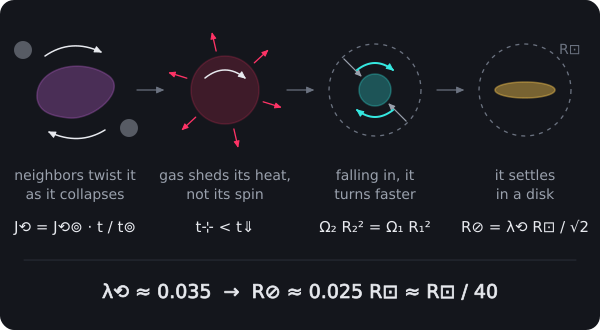
From a Falling Clump to a Whirling Disk. Tidal torques from its neighbors spin a collapsing clump up as J⟲ ∝ t. Its gas, where it cools faster than it falls, radiates its heat but keeps its angular momentum, turns faster as it contracts (Ω · R² kept), and settles in a disk R⊘ = λ⟲ R⊡ / √2, about R⊡/40 for λ⟲ ≈ 0.035. The disk is not drawn to scale.
Disk Rotation G
v⊚ = √(G · M / R)
Dimensional analysis:
Where (from the book): v⊚ [𝕃·𝕋⁻¹], G [𝕄⁻¹·𝕃³·𝕋⁻²], M [𝕄], R [𝕃]
[𝕃·𝕋⁻¹]
√([𝕄⁻¹·𝕃³·𝕋⁻²] × [𝕄] ÷ [𝕃]) = √([𝕃³·𝕋⁻²] ÷ [𝕃]) = √[𝕃²·𝕋⁻²] = [𝕃·𝕋⁻¹]
[𝕃·𝕋⁻¹] = [𝕃·𝕋⁻¹] ✓ Valid PulseCore Verified ✓
A disk turns at the speed that balances gravity at each radius
Where:
- v⊚ [𝕃·𝕋⁻¹] — the speed at which the disk turns at radius R
- G [𝕄⁻¹·𝕃³·𝕋⁻²] — the universe's gravitational coupling
- M [𝕄] — the mass within radius R
- R [𝕃] — the radius
➢ The inner parts of a disk turn faster in angle than the outer, so the disk shears; spiral arms form and wind in it, and stars form along them.
The Heat of the Universe: Cooling Makes the Structures
Gravity gathers the gas; cooling decides what it becomes. Gas falling into a clump is heated by the fall, and it can go on collapsing only if it radiates that heat away faster than it falls (the Cooling Time above). That one comparison, made at every scale, is why the first stars were giants, why the smallest galaxies were left without gas, why ordinary galaxies are supplied by cold streams, and why the largest go red and dead (Rees & Ostriker, 1977; Silk, 1977; White & Rees, 1978).
The universe's own temperature is the floor under all of it. Its light cools as it stretches, and no gas can radiate itself colder than the light it sits in.
Radiation Temperature G
T_γ = T_γ0 · (1 + z)
Dimensional analysis:
Where (from the book): T_γ [Θ], T_γ0 [Θ], z [∅]
[Θ]
[Θ] × ([∅] + [∅]) = [Θ] × [∅] = [Θ]
[Θ] = [Θ] ✓ Valid PulseCore Verified ✓
The universe's light cools as space stretches; no gas cools below it
Where:
- T_γ [Θ] — the temperature of the microwave background at redshift z
- T_γ0 [Θ] — its temperature today, 2.725 K
- z [∅] — the redshift, 1/a − 1
➢ For its first ten million years or so the gas was held at this temperature by the light scattering off its few free electrons; from about z ≈ 150, as those recombined, the gas came loose and cooled faster than the light, as (1 + z)², into the coldest era of the universe, the dark ages (Peebles, 1993; Furlanetto, Oh & Briggs, 2006).
A clump's gas is heated by its fall to the temperature its own gravity sets, the speed of its orbits.
Virial Temperature G
T_vir = μ · mₚ · v_c² / (2 · k_B)
Dimensional analysis:
Where (from the book): T_vir [Θ], μ [∅], v_c [𝕃·𝕋⁻¹]
[Θ]
[∅] × [𝕄] × [𝕃²·𝕋⁻²] ÷ ([∅] × [𝕄·𝕃²·𝕋⁻²·Θ⁻¹]) = [𝕄] × [𝕃²·𝕋⁻²] ÷ ([∅] × [𝕄·𝕃²·𝕋⁻²·Θ⁻¹]) = [𝕄·𝕃²·𝕋⁻²] ÷ ([∅] × [𝕄·𝕃²·𝕋⁻²·Θ⁻¹]) = [𝕄·𝕃²·𝕋⁻²] ÷ [𝕄·𝕃²·𝕋⁻²·Θ⁻¹] = [Θ]
[Θ] = [Θ] ✓ Valid PulseCore Verified ✓
A clump's gravity sets how hot its gas gets as it falls in
Where:
- T_vir [Θ] — the temperature gas reaches when it settles in the clump
- μ [∅] — its mean particle mass in proton masses, about 0.59 when ionized
- mₚ [𝕄] — the proton mass
- v_c [𝕃·𝕋⁻¹] — the speed of a circular orbit in the clump
- k_B [𝕄·𝕃²·𝕋⁻²·Θ⁻¹] — the Boltzmann constant
➢ About 10⁴ K for an orbit of 17 km/s, 10⁶ K for 165 km/s. How fast the gas then radiates is the cooling function Λ, which depends on the temperature and on the metals: primordial hydrogen and helium radiate most near 15,000 K and 100,000 K, and gas with the Sun's metals radiates up to about twenty times faster near 10⁵ K, through oxygen and carbon (Sutherland & Dopita, 1993).
Structure by Structure
The first stars. The first clumps that could cool held about a million Suns, with virial temperatures above about 10³ K. With no metals their gas could radiate only through molecular hydrogen, down to about 200 K, and gas that warm collapses in pieces of a few hundred Suns: the first stars were giants, tens to hundreds of Suns, each alone in its clump (Bromm & Larson, 2004; Hirano et al., 2014). Their supernovae seeded the gas with metals, and above a critical metallicity of about 10^−3.5 of the Sun's the gas can cool to 10 K and fragment into ordinary stars, mostly small (Bromm et al., 2001).
The first galaxies. Clumps with virial temperatures above about 10⁴ K, about 10⁸ Suns at z ≈ 10, cool through atomic hydrogen and contract at about 8,000 K: the atomic-cooling halos, the first true galaxies (Oh & Haiman, 2002; Greif et al., 2008).
Reionization starves the smallest. The first galaxies' ultraviolet light heated the gas between them to about 10⁴ K, finished by about a billion years. Gas that warm cannot settle into clumps whose orbits are slower than its own sound, and the smallest galaxies keep only part of their share of gas (Efstathiou, 1992; Gnedin, 2000; Okamoto, Gao & Theuns, 2008):
Baryon Retention G
f_b = f_b0 / (1 + (2^(2/3) − 1) · (v_f / v_c)^6)^(3/2)
Dimensional analysis:
Where (from the book): f_b [∅], f_b0 [∅], v_f [𝕃·𝕋⁻¹], v_c [𝕃·𝕋⁻¹]
[∅]
[∅] ÷ ([∅] + ([∅]^([∅] ÷ [∅]) - [∅]) × ([𝕃·𝕋⁻¹] ÷ [𝕃·𝕋⁻¹])⁶)^([∅] ÷ [∅]) = [∅] ÷ ([∅] + ([∅]^([∅] ÷ [∅]) - [∅]) × ([𝕃·𝕋⁻¹] ÷ [𝕃·𝕋⁻¹])⁶)^([∅]) = [∅] ÷ ([∅] + ([∅]^([∅]) - [∅]) × ([𝕃·𝕋⁻¹] ÷ [𝕃·𝕋⁻¹])⁶)^([∅]) = [∅] ÷ ([∅] + ([∅] - [∅]) × ([𝕃·𝕋⁻¹] ÷ [𝕃·𝕋⁻¹])⁶)^([∅]) = [∅] ÷ ([∅] + [∅] × ([𝕃·𝕋⁻¹] ÷ [𝕃·𝕋⁻¹])⁶)^([∅]) = [∅] ÷ ([∅] + [∅] × [∅]⁶)^([∅]) = [∅] ÷ ([∅] + [∅] × [∅])^([∅]) = [∅] ÷ ([∅] + [∅])^([∅]) = [∅] ÷ [∅]^([∅]) = [∅] ÷ [∅] = [∅]
[∅] = [∅] ✓ Valid PulseCore Verified ✓
After reionization a small clump keeps only part of its gas
Where:
- f_b [∅] — the share of its gas a clump holds
- f_b0 [∅] — the universe's share, ordinary matter over all matter
- v_f [𝕃·𝕋⁻¹] — the filtering speed, about 25 km/s, below which a clump holds half or less
- v_c [𝕃·𝕋⁻¹] — the clump's circular speed
➢ The form of Gnedin (2000) in mass, M_c / M, with α = 2, written in circular speed (M ∝ v_c³); the filtering speed from Okamoto, Gao & Theuns (2008). This is why there are fewer dwarf galaxies than clumps of dark matter.
Cold streams supply galaxies. Below about 10¹² Suns the infalling gas cools faster than it falls; it never heats to the virial temperature but flows in along the filaments, cold, and flows into the disk directly (Kereš et al., 2005; Dekel et al., 2009).
Hot halos go quiet. Above about 10¹² Suns a standing shock heats the infalling gas to millions of degrees, where it cools more slowly than it falls; the galaxy is cut off from new gas, and its central well, accreting gently, keeps that gas hot (Dekel & Birnboim, 2006; Croton et al., 2006). This is the line between the blue galaxies forming stars and the red ones that have stopped. Checked with the cooling function, at two hundred times the mean density today: gas at 3 × 10⁵ K with a third of the Sun's metals cools in about 0.4 billion years against a free fall of about 2.9, and gas at 10⁶ K takes about 6.6; the line falls near 10⁶ K, an orbit of about 165 km/s, close to 10¹² Suns.
The web is hot. Gas falling onto the filaments is shocked to 10⁵ to 10⁷ K and is too thin to cool: this warm-hot intergalactic medium holds much of the ordinary matter, long missing from the census and now being found (Cen & Ostriker, 1999; Nicastro et al., 2018).
Where the Metals Come From
The cooling above runs on metals, and every metal in the universe was made in a star. The Big Bang made hydrogen, helium and a trace of lithium; everything heavier, the carbon and oxygen that let gas cool twenty times faster, was forged in stars and thrown back into the gas when they died (Burbidge, Burbidge, Fowler & Hoyle, 1957). So the metals are not the universe's but each galaxy's: a galaxy's gas holds the metals its own stars have returned, and a galaxy that has made few stars cools as the first clumps did.
Supernovae make most of them. A star above about eight Suns ends as a core-collapse supernova and throws off its shells, oxygen above all, with neon, magnesium, silicon and some iron; integrated over a population of stars, oxygen from these supernovae is about two thirds of all the metals made (Nomoto, Kobayashi & Tominaga, 2013; Vincenzo et al., 2016). A metal-free giant of 140 to 260 Suns dies by pair instability: its helium core, 64 to 133 Suns, burns almost wholly to oxygen, silicon and iron, and the whole star is thrown off, about half of it as metals (Heger & Woosley, 2002). The rest comes later and smaller: carbon and nitrogen from the winds of dying stars of one to eight Suns (Karakas & Lattanzio, 2014), and iron from Type Ia supernovae, white dwarfs that explode after a delay of up to billions of years, about one for every thousand Suns of stars formed, each with about 0.7 Suns of iron (Maoz & Mannucci, 2012), a few hundredths of all metals by mass. The heaviest, gold and uranium, come from merging neutron stars (Kobayashi, Karakas & Lugaro, 2020).
What a dying star gives back is the metals it was born with and the metals it made:
Metals Returned G
M_Z = M_ej · (Z_★ + p_Z)
Dimensional analysis:
Where (from the book): M_Z [𝕄], M_ej [𝕄], Z_★ [∅], p_Z [∅]
[𝕄]
[𝕄] × ([∅] + [∅]) = [𝕄] × [∅] = [𝕄]
[𝕄] = [𝕄] ✓ Valid PulseCore Verified ✓
A dying star returns its birth metals and the metals it made
Where:
- M_Z [𝕄] — the mass of metals the star returns to the gas
- M_ej [𝕄] — the mass it throws off, its birth mass less its remnant
- Z_★ [∅] — the metal share of the gas it was born from
- p_Z [∅] — the share of its ejecta that is new metals: none for a star that dies quietly, about half for a pair-instability giant
➢ The ejecta mix first through the gas of the star's own cloud, the reach of its remnant, within tens of millions of years, and through the galaxy more slowly (de Avillez & Mac Low, 2002).
Summed over all the stars a population forms, the metals made are measured by the net yield:
Net Metal Yield G
y_Z = M_Z,new / (M_★ · (1 − R))
Dimensional analysis:
Where (from the book): y_Z [∅], M_Z,new [𝕄], M_★ [𝕄], R [∅]
[∅]
[𝕄] ÷ ([𝕄] × ([∅] - [∅])) = [𝕄] ÷ ([𝕄] × [∅]) = [𝕄] ÷ [𝕄] = [∅]
[∅] = [∅] ✓ Valid PulseCore Verified ✓
The new metals a generation of stars makes, per mass it leaves in stars
Where:
- y_Z [∅] — the net metal yield
- M_Z,new [𝕄] — the new metals the generation returns
- M_★ [𝕄] — the mass of stars it formed
- R [∅] — the return fraction, the share of that mass thrown back as gas
➢ For the Kroupa (2001) Initial Mass Function and the yields of Nomoto, Kobayashi & Tominaga (2013), y_Z ≈ 0.05 and R ≈ 0.43 at metallicities from a thousandth of the Sun's to the Sun's, so new metals are about 0.029 of the mass of stars formed; the yield changes by a factor of more than three across the mass functions in use (Vincenzo et al., 2016).
A galaxy that kept all its gas and all its metals would follow the closed box:
Closed-Box Metallicity G
Z = y_Z · ln(1 / μ_g)
Dimensional analysis:
Where (from the book): Z [∅], y_Z [∅], μ_g [∅]
[∅]
[∅] × ln([∅] ÷ [∅]) = [∅] × ln([∅]) = [∅] × [∅] = [∅]
[∅] = [∅] ✓ Valid PulseCore Verified ✓
The metals of a galaxy that keeps all its gas
Where:
- Z [∅] — the metal share of the galaxy's gas
- y_Z [∅] — the net metal yield
- μ_g [∅] — the gas share of the galaxy's ordinary matter
➢ Searle & Sargent (1972); Tinsley (1980). A galaxy reaches the Sun's metals, Z ≈ 0.019, when about a third of its gas has become stars. The Milky Way, a tenth gas, would hold six times the Sun's metals; it holds about the Sun's, because fresh gas keeps falling in and winds carry metals out. Winds escape small galaxies most easily, so small galaxies hold fewer metals: the mass–metallicity relation, measured in 53,000 galaxies (Tremonti et al., 2004).
Winds: Why Small Galaxies Hold Fewer Metals
A galaxy's supernovae do more than stir its gas. Where many explode together their hot bubbles merge and break out of the disk, and a wind of gas, carrying the fresh metals with it, leaves the galaxy at hundreds of kilometers a second; it is seen in starburst galaxies near and far, and the metals it carries fill the gas between the galaxies (Larson, 1974; Dekel & Silk, 1986; Chisholm, Tremonti & Leitherer, 2018). The wind takes the gas and leaves the stars. How much it carries out is set by energy: a share of the supernovae's energy lifts gas out of the galaxy's well.
Wind Mass Loading G
η_w = 2 · ε_w · E_SN · n_SN / v_esc²
Dimensional analysis:
Where (from the book): η_w [∅], ε_w [∅], E_SN [𝕄·𝕃²·𝕋⁻²], n_SN [𝕄⁻¹], v_esc [𝕃·𝕋⁻¹]
[∅]
[∅] × [∅] × [𝕄·𝕃²·𝕋⁻²] × [𝕄⁻¹] ÷ [𝕃²·𝕋⁻²] = [∅] × [𝕄·𝕃²·𝕋⁻²] × [𝕄⁻¹] ÷ [𝕃²·𝕋⁻²] = [𝕄·𝕃²·𝕋⁻²] × [𝕄⁻¹] ÷ [𝕃²·𝕋⁻²] = [𝕃²·𝕋⁻²] ÷ [𝕃²·𝕋⁻²] = [∅]
[∅] = [∅] ✓ Valid PulseCore Verified ✓
The gas a galaxy's supernovae blow out, per mass of stars formed
Where:
- η_w [∅] — the mass loading: gas blown out per mass of stars formed
- ε_w [∅] — the share of a supernova's energy that drives the wind, about a tenth, what is left as motion when its remnant has radiated the rest
- E_SN [𝕄·𝕃²·𝕋⁻²] — the energy of one supernova, 10⁵¹ erg
- n_SN [𝕄⁻¹] — supernovae per mass of stars formed, about one per hundred Suns for the Kroupa mass function
- v_esc [𝕃·𝕋⁻¹] — the escape speed from the galaxy
➢ Energy-driven: η_w ∝ v_c⁻², a dwarf losing many times the gas it turns into stars and a large galaxy a fraction of it (Dekel & Silk, 1986; Murray, Quataert & Thompson, 2005). ε_w ≈ 0.1 from the remnants of Thornton et al. (1998). It gives η_w ≈ 4 at an orbit of 60 km/s, as the FIRE simulations measure, about 3.6 (Muratov et al., 2015), 1.5 at 100 km/s and 0.4 at 200.
The escape speed is the galaxy's own: for a halo whose orbits all run at about v_c, out to its edge,
Halo Escape Speed G
v_esc = v_c · √(2 · (1 + ln(rₜ / r)))
Dimensional analysis:
Where (from the book): v_esc [𝕃·𝕋⁻¹], v_c [𝕃·𝕋⁻¹], rₜ [𝕃], r [𝕃]
[𝕃·𝕋⁻¹]
[𝕃·𝕋⁻¹] × √([∅] × ([∅] + ln([𝕃] ÷ [𝕃]))) = [𝕃·𝕋⁻¹] × √([∅] × ([∅] + ln([∅]))) = [𝕃·𝕋⁻¹] × √([∅] × ([∅] + [∅])) = [𝕃·𝕋⁻¹] × √([∅] × [∅]) = [𝕃·𝕋⁻¹] × √[∅] = [𝕃·𝕋⁻¹] × [∅] = [𝕃·𝕋⁻¹]
[𝕃·𝕋⁻¹] = [𝕃·𝕋⁻¹] ✓ Valid PulseCore Verified ✓
The speed gas needs to leave a galaxy's halo
Where:
- v_esc [𝕃·𝕋⁻¹] — the escape speed at radius r
- v_c [𝕃·𝕋⁻¹] — the circular speed of the halo
- rₜ [𝕃] — the halo's edge
- r [𝕃] — where the gas starts
➢ The truncated isothermal sphere (Binney & Tremaine, 2008). For gas in the disk, about a tenth of the halo's reach, v_esc ≈ 2.6 v_c.
A galaxy whose metals are made by its stars and carried off by its wind settles where the two balance:
Equilibrium Metallicity G
Z_eq = y_Z / (1 + η_w)
Dimensional analysis:
Where (from the book): Z_eq [∅], y_Z [∅], η_w [∅]
[∅]
[∅] ÷ ([∅] + [∅]) = [∅] ÷ [∅] = [∅]
[∅] = [∅] ✓ Valid PulseCore Verified ✓
A galaxy's metals where its winds balance its stars
Where:
- Z_eq [∅] — the metal share its gas settles at
- y_Z [∅] — the net metal yield
- η_w [∅] — its wind mass loading
➢ Finlator & Davé (2008), with the gas falling in balancing what it uses. With y_Z ≈ 0.05: about half the Sun's metals at an orbit of 60 km/s, the Sun's at 100 and twice it at 200, the measured mass–metallicity relation, a third of the Sun's in galaxies of 10⁸·⁵ Suns of stars rising to about one and a half times it at 10¹¹ (Tremonti et al., 2004). Much of the wind falls back over a billion years or so, a galactic fountain, and is used again (Oppenheimer et al., 2010).
The game's reading. Each galaxy's gas has a temperature. A universe's times are read as fractions of its life, its life the 11.0 billion years of ours at level 202 (Part 1.D), as star formation reads its depletion time; its scale factor sets the redshift, and the radiation temperature its floor. The motion its matter has round its well, measured (on the torus's surface ⟨v²⟩ = v_c² for a settled clump), taken from comoving cells to a physical speed by the scale factor and set against light speed, gives its virial temperature: gas falling in at that speed is shocked to it; its gas at two hundred times the mean density, its metals and the cooling function of Sutherland & Dopita give its cooling time, and its free fall at that density its fall. Its gas forms stars at the full rate while it cools faster than it falls, and at t⇓/t⊹ of it when it does not; a supernova's or quasar's heat stops the gas round it until it has cooled again, over its own cooling time. From reionization, a fifteenth of the way through the life (about 0.75 billion years, z ≈ 7), Baryon Retention starves the slowest galaxies. Each clump of gas carries its own metals, and they are read cloud by cloud: a star is born with its cloud's metals, and dying returns them by Metals Returned into its cloud, with new metals from a core-collapse supernova at p_Z = 0.17, the one share that makes the game's own population return the yield above (its supernovae throw off 0.168 of the mass of stars formed; 0.029 ÷ 0.168), and from a pair-instability giant its helium core, 64 to 133 Suns of its 140 to 260. A galaxy cools at the metals of its own gas. A cloud with fewer metals than the critical metallicity makes stars of ten to three hundred Suns. Each supernova in a galaxy drives a wind by Wind Mass Loading, 2ε_w E_SN / v_esc² of gas for each supernova, its v_esc 2.6 times the galaxy's measured circular speed: the gas, with the metals it holds, fresh ones too, is taken from the supernova's cloud and leaves from it at the escape speed, outward from the galaxy's center, too hot to form stars for the galaxy's cooling time; the stars stay. Where it lands, in the gas between the galaxies or back in a galaxy, it is gas again. Type Ia iron and the winds of small stars, a few hundredths of the metals, are not yet made.
Where It Meets the Pulse
Spin, in this book, is never a property of a single pulse. It is born of orbit (Chapter 1, Part Z.11): a universe inherits its spin from the merger of the wells that made it (Part 6.9), and inside a universe every clump of matter gains its own from the uneven pull of the matter around it. Both are the same law, angular momentum gained from an orbit that is not symmetric, at the scale of a universe and at the scale of a galaxy. The spin a universe inherits sets its own turning and its preferred axis (Part 6.9); the spin of each clump is its own, in its own direction, so a universe is full of disks turning every way. And because every particle is a swarm of data (Part 2.9, the Data–Matter Equivalence), the data turns with the disks: every whirling disk is wrapped in its own spiral of data.
The Game's Reading
The simulation follows this order. Its matter begins as a jittered grid, each piece placed at random within its own cell so that no row survives, an approximation to a glass. Its ripples are a random field with the Primordial Ripple Spectrum, whose phases are drawn from the universe's own data, shaped by the scaffold, so the web is a tangle that follows the lattice loosely. The tidal torques act by themselves once the matter moves under its own gravity, with no spin given to any piece. Gas in a cloud dense enough to cool, where the cooling time is shorter than the free fall, loses its motion toward and away from the cloud's centre over a cooling time and keeps its motion round it, so it falls in turning faster and settles into a whirling disk; the stars born from it turn with it.
3.12 Testable Predictions
- The spins of clumps and galaxies point every way, set by their neighbours, while a universe as a whole has one inherited axis (Part 6.9): galaxy spins should correlate with the filaments they formed in, as tidal torques predict, and weakly with the universe's axis
- Disks settle at about λ⟲/√2 ≈ 2.5 % of their clumps' size
- Only gas whose cooling time is shorter than its free fall forms disks: the most massive clumps, too hot to cool, hold their gas puffed up, as galaxy clusters do
Chapter 3 Review
Chapter 3 has established the mathematical frameworks linking Binary Pulse Theory's computational foundations to observable physical phenomena, proposing that computation doesn't just model reality — it creates it. Through its derivations and formulations, it has proposed how binary state transitions generate quantized energy expressions, how topological constraints prevent computational divergence while enabling structural complexity, and how recursive accumulation leads to deterministic threshold events triggering cosmic expansion.
Computational Energy
The Base Calculation provides the proposed mechanism by which computational processes generate measurable physical energy through E⊶ = ℏ × ω₁ × n○ (Bennett, 1973; Planck, 1900)³,³⁰. This proposal draws a direct correspondence between binary state changes and quantum mechanical energy quantization, offering an account of energy's origin and addressing the gap between information theory and physical energy predicted by Wheeler's "it from bit" hypothesis (Wheeler, 1989).
The temporal quantum ①⥂⧖♁ = ①⥂⧗♁/2 creates architectural foundations upon which all energy generation operates, ensuring consistency with quantum gravitational time scales while providing discrete computational resolution for recursive development (Planck, 1900; Ashtekar, 2004)⁵. Planck time isn't fundamental — it emerges from more fundamental binary operations, reversing the usual assumptions about temporal fundamentals.
Folding Stability
The Folding Mechanism introduces essential topological constraints through ⥂(n) = [(n+1)² mod F(n)] × Ψ⧝, drawing inspiration from crystallographic symmetries (Burns & Glazer, 1990). This prevents recursive divergence that would otherwise destabilize computational systems while preserving structural complexity necessary for emergence — addressing the computational stability problem long studied in complex systems theory.
The Stability Index SI(n) = 1 - (folded_output/F(n)) × β⚖ provides quantitative measures of system stress relative to topological limits, with the coefficient β⚖ = 0.18 adopted here (a parameter of the index, not a measured value). BPT proposes it as a universal constant governing how complex systems maintain stability without collapse.
Data Nova: Information Overflow Becomes Physical Energy
The Recursive Integration process E⊚(T) = ∫₀ᵀ C(t) × τ𝓕 × I(t) × Ψ◊(t) dt demonstrates how computational complexity accumulates over discrete temporal frames until reaching critical threshold conditions (Kadanoff, 2000). Data Nova events suggest computational overflow creates physical energy release — bridging information and physics fundamentally.
Data Nova events occur when accumulated energy density exceeds substrate capacity according to E⊚(T) ≥ κ × Ω⚕⥂ × P⊡ × τ⥂ × F⊜, providing deterministic rather than mysterious cosmic expansion initiation (Hawking, 1975).
Dimensional Creation Through Toroidal Genesis
Toroidal Genesis and Data Nova Escalation establish that dimensional expansion occurs through quantized structural transitions rather than smooth cosmic inflation (Guth, 1981). The Recursive Capacity Law f(r) = (2r)² determines when accumulated computational capacity exceeds Toroidal Substrate containment, triggering dimensional reorganization at threshold r* = ceil(√(χ_∂) / 2).
BPT proposes the torus topology as the structure best suited to containing recursive processes, which would explain why torus shapes appear throughout physics as nature's preferred processing architecture. The Dimensional Saturation Threshold at D⥣ suggests that Universe evolution follows biological-like maturation, where post-saturation Harmonic Novas add inner layers and maintain stability rather than creating new spatial axes (Kauffman, 1995).
The True Big Bang: Pulse Convergence
In BPT, the True Big Bang was not a mysterious explosion but inevitable computational convergence. When recursive Data Density exceeded substrate capacity through ρℹ ≥ ρ⨶ = PD⁻³ × C※⥣ × F◊⨶, dimensional breakthrough became mathematically certain — BPT's account of cosmic origin through computational determinism.
The Information Preservation Principle I◁-⋒ = I☐ + I⧗ + I⚛ + I⟐ extends Wheeler's "it from bit" to cosmological scales (Wheeler, 1989), ensuring total information conservation during all transformation events.
Ignition Loops: The Operational Bridge
Ignition Loops (G) provide operational pathways from theoretical thresholds to actual cosmic expansion through self-sustaining feedback cycles with amplification coefficient γ > 1, following laser physics principles (Strogatz, 1994). These loops transition systems from dissipative (ε⟹ < 0) to amplifying behavior once accumulated energy exceeds E⨶⟳.
The deterministic ignition condition E⊚ ≥ T⥣ ensures computational rather than probabilistic cosmic creation, with energy release following first-order kinetics dE⟹/dt = -κ × (E⊚ - E⚖), maintaining thermodynamic consistency. This provides BPT's mechanism by which information processing creates tangible reality — its account of how computation becomes cosmos.
Fractal Universe Reproduction
Fractal Progeny through Null Well Collapse demonstrates Universe reproduction capability when accumulated tension exceeds T⨶ = HFC × ①⥂⧖‵ × R⚚, following cosmological natural selection principles (Smolin, 2013). A child's Tempo follows the mass of the well that seeds it, ①⥂⧗′⌂ = ①⥂⧗⌂ · (M∅/M_P)^½ · ⟪C⟫, never below ℨ, creating lawful variation across generations.
Universes reproduce like living organisms through computational overflow events, making cosmic reproduction as natural as biological reproduction — but operating through computational rather than chemical processes. The Dual-Axis Recursion framework with vertical scaling ①⥂⧖(n) = 2ⁿ · fⁿ · ↁℨ⧖ establishes infinite genealogical structure with our Universe positioned at layer n = 202 (Hawking, 1988).
Silent Wells: The Return to the Source
A completed universe resolves into a Silent Well, a non-spatial archive that preserves its full temporal signature, Local Pulse Tempo, phase, amplitude and frequency, so that nothing it computed is lost. The archived data returns through the Data Loop to the UniSpheral Data Source (℧), where its return weight joins the UniSphere Pulse Compulsion Law and keeps the primordial pulse at ℨ running. A collapse that seeds no child returns its data the same way, without continuing back out into a new cycle.
The return adds no second rhythm. As the Harmonic Novas of Part 3.6 refine a saturated lattice instead of adding to it, the returning data reinforces the one Binary Pulse already running: outward branching and inward return form a single circuit.
Implications
Binary Pulse Theory aims to stay consistent with established physics while proposing deeper computational foundations. Energy conservation holds through E⊚ = E① + E_dissipated + E▢ (Weinberg, 1995), quantum mechanical correspondence appears in E_n = ℏ × ω × (n + 1/2), and relativistic effects emerge through F⌂ = 1/[τ_0 × √(1 - v²/𝒞→²) × ρ▱^α] (Misner et al., 1973)²⁴.
The Universal Grid Principle states BPT's view of reality: there is only one grid, and we are all patterns within it. Every conscious being, particle, force, and physical law emerges from binary dynamics of this single, pixelated grid. We don't inhabit separate realities — we are interconnected patterns sharing the same fundamental substrate, experiencing it from different harmonic levels and perspectives.
Scientific Impact
Chapter 3 proposes that consciousness, computation, and cosmos emerge from the same fundamental substrate — binary computational processes operating across infinite scales. Information appears not as abstract concept but as fundamental constituent of reality, with energy and matter representing different storage modes within computational substrate (Fredkin, 2003; Wolfram, 2002),⁴⁴.
The deterministic nature of threshold crossing events eliminates arbitrary cosmic creation, replacing mysterious singularities with precise computational processes that can be calculated, predicted, and potentially controlled. Every cosmic event, from particle creation to galactic formation, results from computational processes reaching critical thresholds — suggesting the Universe operates through computational necessity, not random chance.
Future Research Directions
The mathematical frameworks established in Chapter 3 open numerous research directions: precision tests of ①⥂⧖-interval timing in quantum systems, development of computational cosmology based on recursive integration, investigation of folding mechanisms in condensed matter systems, and experimental verification of Data Nova overflow events.
The integration of computational and physical perspectives suggests potential applications in quantum computing, artificial intelligence, and cosmological engineering based on understanding and manipulating the recursive substrate underlying reality itself. BPT proposes that reality is computation, and computation is energy generation — opening possibilities for computational control of physical phenomena.
Binary Pulse Theory proposes that the Universe doesn't just compute — it computes itself into existence through recursive mathematical processes operating across infinite scales and epochs. This is the computational cosmos: the view that we inhabit not a merely physical Universe but a vast computational system that has achieved consciousness of its own computational nature.
And the chapter closes where the book opened. A universe forms its wells, the last of them at its rupture, and then dissipates into null; in each of those wells a new UniSphere bifurcates, ∅ → (0 ⥂ 1), one generation on. Universal Dissipation and the Return to Bifurcation make the Prime Pulse not only the first event but the only one: everything in between is a universe computing its way back to it.