Chapter 4 · Section 8
Prime Harmonics and the Dimensions
Why does a universe have the dimensions it has, and could another have more? Part 3.6 bounds the binding rule that sets the saturation D⥣ without deriving it, and Part 4.1 gives the three kinds, the Dimensional Triad, and builds the ladder of layers on doublings, each new dimension at twice the pulses (2ⁿ). But a harmonic series is not a ladder of doublings. It is every whole multiple of a fundamental, 1, 2, 3, 4, 5, 6, 7 and on, and the doublings, 1, 2, 4, 8, the octaves, are only one thread through it. This part reads the dimensions from the whole series, and finds the four we live in at its head.
The Harmonic Series, Not the Octave
Harmonic Series G
fₕ = h · f₁
Dimensional analysis:
Where (from the book): fₕ [𝕋⁻¹], h [∅], f₁ [𝕋⁻¹]
[𝕋⁻¹]
[∅] × [𝕋⁻¹] = [𝕋⁻¹]
[𝕋⁻¹] = [𝕋⁻¹] ✓ Valid PulseCore Verified ✓
Every whole multiple of the fundamental, not only its doublings
Where:
- fₕ [𝕋⁻¹] — the frequency of harmonic h
- h [∅] — the harmonic's number, any whole number
- f₁ [𝕋⁻¹] — the fundamental: for a universe's layers, the note of its space, f_S, its Alpha moved up by whole octaves (Part 4.9), so the ratios are the same as over the Alpha itself
➢ The octaves are the powers of two, h = 1, 2, 4, 8, and repeat the fundamental's own pitch; every other harmonic brings a relation the octaves cannot make. Data Harmonics (Part 3.6) numbers a universe's layers the same way, Harmonic 1, 2, 3, 4 and on, whole numbers, not doublings.
Primes as Independent Axes
Every whole number is a product of primes in exactly one way, the fundamental theorem of arithmetic (Hardy & Wright, 2008). So every harmonic, and every ratio between two harmonics, is a point in a lattice with one independent axis for each prime: 2, 3, 5, 7, 11 and on. Euler drew this lattice in 1739 to map musical harmony (Euler, 1739); Partch built a music on its first primes (Partch, 1974); and Tenney made it a space with a measured distance (Tenney, 1983). A harmonic built from 2 and 3 alone, like 6 or 9 or 12, adds no new axis: it is a combination of the ones already there.
Harmonic Factorization G
h = 2^a · 3^b · 5^c · 7^d
Dimensional analysis:
Where (from the book): h [∅], a [∅], b [∅], c [∅], d [∅]
[∅]
[∅]^([∅]) × [∅]^([∅]) × [∅]^([∅]) × [∅]^([∅]) = [∅] × [∅]^([∅]) × [∅]^([∅]) × [∅]^([∅]) = [∅] × [∅] × [∅]^([∅]) × [∅]^([∅]) = [∅] × [∅]^([∅]) × [∅]^([∅]) = [∅] × [∅] × [∅]^([∅]) = [∅] × [∅]^([∅]) = [∅] × [∅] = [∅]
[∅] = [∅] ✓ Valid PulseCore Verified ✓
Every harmonic is a point on the prime axes
Where:
- h [∅] — a harmonic's number
- a [∅] — its steps along the axis of 2, the octave
- b [∅] — its steps along the axis of 3
- c [∅] — its steps along the axis of 5
- d [∅] — its steps along the axis of 7
➢ Written to the four primes that carry our universe's dimensions; a universe with more actual dimensions carries the next primes too, 11, 13 and on, each a further factor of the same form.
Fundamental and Etheric Dimensions
Binary Pulse Theory reads a universe's dimensions from this lattice. Its fundamental, or actual, dimensions are its prime harmonics, each a relation no other harmonic can make. The composite harmonics, 4, 6, 8, 9, 10 and on, are its Etheric Harmonics: real and present, but built on the primes, the harmonic reinforcement of Part 3.6 rather than independent dimensions; and an etheric harmonic exists only on fundamentals that carry. The actual dimensions are the primes a universe holds in tune, up to its prime limit p⥣, so D is the count of primes up to p⥣.
- 2, the octave: the pulse doubling itself, 0 → 1 → 0 repeated, the Binary Pulse; read as time, the one dimension made of the pulse's own repetition.
- 3, 5 and 7: the three odd primes, read as the three dimensions of space.
- 9 = 3 × 3: the first composite after them, the first etheric harmonic, reinforcing space rather than adding to it.
That is three and one, read from the head of the harmonic series. It is a reading, not yet a derivation: the theory has still to show why the prime 2 is time and the odd primes are space, though Part 4.9 finds the same split in the shape of the pulse itself, whose own overtones are the odd harmonics alone.
The Etheric Layers
What are the layers past the actual dimensions? Not more directions to move in. Physics has asked what a fourth direction of space would be like, and the answer is that nothing built of matter could last in it: with more than three, gravity and light fall off faster than the square of distance, and no orbit is stable, of a planet round its star (Ehrenfest, 1917) or of an electron round its nucleus (Tangherlini, 1963); with more than one dimension of time, the present no longer fixes the future (Tegmark, 1997). Where physics has proposed more dimensions, it has made them unseen: curled smaller than any atom, where one more gives electromagnetism (Kaluza, 1921; Klein, 1926) and string theory's six or seven set the particles and forces; or larger but closed to everything except gravity (Arkani-Hamed, Dimopoulos & Dvali, 1998; Randall & Sundrum, 1999), which searches have not found; or as a less physical description from which space itself is built, a boundary of information whose entanglement makes the geometry within it (Maldacena, 1998; Van Raamsdonk, 2010).
Binary Pulse Theory reads them as layers of structure, and they are its Etheric Harmonics. Each etheric layer is a composite harmonic, built on the prime ones, so it opens no new axis: it is a structure every point of the actual dimensions carries, the way a particle carries its charge. The first is Harmonic 4, the first overtone, 2 × 2: time's own doubling, the main note returning, which adds no direction to anything, the reinforcement of Part 3.6; spacetime itself is Harmonic 3, the coupling of space and time (the Dimensional Triad, Part 4.1). The layers below the actual dimensions in the order of the Novas, space and the data lattice, run toward the physical: the null, then the information laid on it, then matter. The etheric layers run the other way, away from matter: each later layer is held less in matter and more in the data the universe is made of, as the composite harmonics stand further from the primes that carry them. In this theory data is not less real than matter but prior to it, and a pattern held in data is not less real for being held there.
Nothing in the theory rules out structures in the etheric layers as complex and as lasting as any in the physical, and the theory does not say what, if anything, they hold. What it says is where they are: built on the actual dimensions, present at every point of them, and further from matter the higher they stand.
Where a Universe Stops Holding Its Harmonics
A harmonic counts as a dimension only while a universe holds it in tune with the rest. In music the same limit is heard: consonance falls as a ratio grows complex (Helmholtz, 1863; Plomp & Levelt, 1965), and the harmonics up to 7 are heard as consonant while 11 and 13 are heard as out of tune, which is why tuning theory speaks of the "7-limit". Tenney measured a ratio's complexity by its harmonic distance.
Harmonic Distance G
H = ln(p · q) / ln(2)
Dimensional analysis:
Where (from the book): H [∅], p [∅], q [∅]
[∅]
ln([∅] × [∅]) ÷ [∅] = ln([∅]) ÷ [∅] = [∅] ÷ [∅] = [∅]
[∅] = [∅] ✓ Valid PulseCore Verified ✓
How far a ratio p/q lies from the fundamental in the prime lattice
Where:
- H [∅] — the harmonic distance of the ratio p/q, in octaves
- p [∅] — the ratio's numerator, in lowest terms
- q [∅] — its denominator
➢ Tenney's height (Tenney, 1983): 3/2 lies at log₂ 6 ≈ 2.6, 5/4 at log₂ 20 ≈ 4.3, 7/4 at log₂ 28 ≈ 4.8, 11/8 at log₂ 88 ≈ 6.5. A universe that holds harmonics in tune to a greater distance holds more primes, and so more actual dimensions.
The binding rule is what fixes that distance for each level. It is not yet derived; the candidate is the pulse's own spectrum (Part 4.9), whose odd harmonics weaken as 2/(π·h), 3, 5 and 7 carrying 0.21, 0.13 and 0.09 of the fundamental and 11 only 0.06, so a threshold falling with level would give the ladder below. Three things the rule must give are known. The Zinf, level 0, reaches Harmonic 3 and no further (the Layer Count Law, h⥣(0) = 3), so it holds the primes 2 and 3 alone: D = 2. Level 1, the first universe to reach an overtone, reaches Harmonic 6 (h⥣(1) = 6), so it holds the primes 2, 3 and 5: D = 3 at most. The prime 7 first sounds within a life at level 2 (h⥣(2) = 12): D = 4 from there. And at our level D is still 4, which our own sky measures (below). A larger universe could hold harmonics in tune further, to 11 or 13, and so have a fifth or sixth actual dimension; if the coherence requirement of Part 4.1 is the rule, the harmonic distance it allows must reach 7 but not 11 at level 202, and grow beyond.
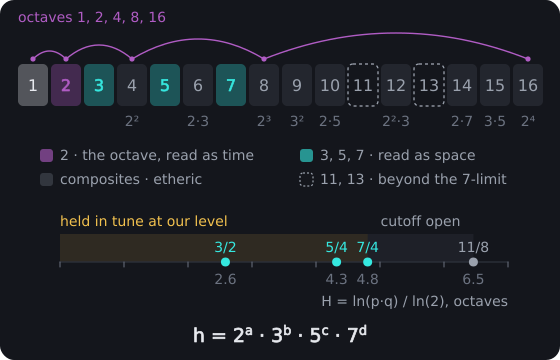
Prime Harmonics and the Dimensions. Every harmonic factors over the primes, h = 2ᵃ · 3ᵇ · 5ᶜ · 7ᵈ: the octave 2 is read as time, the odd primes 3, 5 and 7 as space, and the composites as etheric harmonics. The harmonic distance H = ln(p · q) / ln(2) places 3/2, 5/4 and 7/4 within the 7-limit our level holds and 11/8 beyond it; where the cutoff falls between them is set by the binding rule, not yet derived (above).
A note is never one note. Strike an A and its overtones sound with it, at whole multiples of its pitch, each fainter than the last, in ratios nobody adds: the E, the C♯ and the G are already inside the A. Pythagoras heard it first, on a stretched string, where the octave, the fifth and the fourth answered to the lengths 2 : 1, 3 : 2 and 4 : 3, whole numbers found inside nature, the oldest root of this book's claim that the world is number (as the tradition records it, Nicomachus, c. 100 CE); Fourier (1822) proved the rest, that every repeating wave is a sum of whole multiples of its pitch. That is the whole of this Part heard rather than counted. A universe is a note struck; its dimensions are the overtones that come with the note. Fold every overtone into one octave, halving it until it lies between the root and its double, and every power of two falls on the root while each odd harmonic becomes one distinct note: time is the fold, and the odd harmonics are the notes of space laid out in a single octave. From A at 440 Hz, with the role each overtone plays in the theory:
| h | Hz | nearest note | off by (cents) | folded into one octave | in the theory |
|---|---|---|---|---|---|
| 1 | 440 | A4 | 0 | 1/1, the root | the main note: space |
| 2 | 880 | A5 | 0 | the root | time, the doubling |
| 3 | 1320 | E6 | +2 | 3/2, the fifth | the first axis: the physical |
| 4 | 1760 | A6 | 0 | the root | the first overtone: nothing new |
| 5 | 2200 | C♯7 | −14 | 5/4, the major third | the second axis |
| 6 | 2640 | E7 | +2 | 3/2 again | etheric, 3 × 2 |
| 7 | 3080 | G7 | −31 | 7/4, the harmonic seventh | the third axis |
| 8 | 3520 | A7 | 0 | the root | time |
| 9 | 3960 | B7 | +4 | 9/8, the major second | etheric, 3 × 3 |
| 10 | 4400 | C♯8 | −14 | 5/4 again | etheric, 5 × 2 |
| 11 | 4840 | between D8 and D♯8 | +51 from D | 11/8, a quarter-tone | the fourth axis, not held at our depth |
| 12 | 5280 | E8 | +2 | 3/2 again | etheric, 3 × 4 |
| 13 | 5720 | between F8 and F♯8 | +41 from F | 13/8 | the fifth axis, not held at our depth |
| 14 | 6160 | G8 | −31 | 7/4 again | etheric, 7 × 2 |
| 15 | 6600 | G♯8 | −12 | 15/8, the major seventh | etheric, 3 × 5 |
| 16 | 7040 | A8 | 0 | the root | time |
Within the octave no note repeats; a note returns only at its double, an octave up, so the series grows by doubling, each octave holding twice the harmonics of the last, its new notes the odd numbers. The primes among them are the axes, 3, 5 and 7 for us; the odd composites, 9 and 15, are etheric from the start; and 11 and 13 fall between the keys of our scale, which is the musical sign of a prime a universe does not hold in tune (the author, 16 November 2026).
The Sky Measures the Count
Part 3.9 derives the share of collapses that fail as 2^(−D), and Part 3.13 counts from it a universe's ratio of dark matter to ordinary matter, (1 − 2^(−D)) · 144/25. Read backwards, our sky's ratio, 5.36 ± 0.06, measures D = 3.85 (+0.23 / −0.20): four actual dimensions, the primes 2, 3, 5 and 7, with three ruled out at five standard deviations and five at more than three. The dark matter of a universe counts its dimensions, and ours counts four.
Testable Predictions
- Four, and no fifth, at our depth: no physical phenomenon at our level should need an independent fifth dimension; what seems to should reduce to etheric harmonics of the four (Part 3.6).
- Dark matter tracks dimensions: a universe with D actual dimensions shows a dark-to-ordinary ratio of (1 − 2^(−D)) · 144/25: 5.04, 5.40, 5.58 and 5.67 for three to six.
- The 7-limit in nature's own resonances: where a system of our universe resonates freely, its stable ratios should be built from 2, 3, 5 and 7, the primes our universe holds in tune.
Links to Binary Pulse Theory
- Part 3.6: Data Harmonics numbers the layers as whole harmonics; the Dimensional Saturation Threshold is the prime limit, and the binding rule, not yet derived, is its cutoff.
- Part 3.9: the Dimensional Failure Law, P⦰ = 2^(−D), counts the actual dimensions.
- Part 3.13: the dark-matter ratio measures D.
- Part 4.1: the dimensional ladder of doublings is the octave thread of the series; its coherence requirement is the candidate for the cutoff.
- Part 4.9: the pulse's own waveform holds the odd harmonics alone, time and space in its spectrum.