Chapter 4 · Section 9
The Note of a Universe
If a universe is built on a pulse, it has a pitch. Every universe in this book is a Binary Pulse, 0 → 1 → 0, repeated at its own Local Pulse Tempo, and a repeated wave is a note. This part gives the shape of that wave, the harmonics it holds, and the note it sounds, ours among them.
The Shape of the Prime Pulse
The pulse jumps between two states, 0 and 1, and holds each for a Pulse Rhythm, half a Tempo. A wave that holds one level for half its cycle and the other for the rest is a square wave. Fourier showed that every repeating wave is a sum of sine waves at whole multiples of its frequency (Fourier, 1822), and a square wave has a famous sum: the fundamental, and then only the odd harmonics, each weaker in proportion to its number.
Square Pulse Spectrum G
aₕ = 2 / (π · h)
Dimensional analysis:
Where (from the book): aₕ [∅], h [∅]
[∅]
[∅] ÷ ([∅] × [∅]) = [∅] ÷ [∅] = [∅]
[∅] = [∅] ✓ Valid PulseCore Verified ✓
The pulse holds its fundamental and its odd harmonics alone
Where:
- aₕ [∅] — the strength of harmonic h in the pulse, for odd h; for even h it is 0
- h [∅] — the harmonic's number
➢ The Fourier series of a wave that is 1 for half its cycle and 0 for the other half: a steady half, then 2/π for the fundamental, 2/(3π) for the third harmonic, 2/(5π) for the fifth, 2/(7π) for the seventh, and nothing at the even harmonics.
The pulse's own spectrum is the split of Part 4.8. There are no octaves inside the wave: the doubling is not a harmonic of the pulse but its repetition, the dimension made of the pulse itself, time. Its strongest overtones are 3, 5 and 7, the three odd primes read as space, and the next, 9, is the first composite, an etheric harmonic. The first note holds three and one in the order of its own overtones. The even harmonics a universe sounds come from its layers instead: the novas, numbered as harmonics by Data Harmonics, add 2, 4, 6 and on as they come.
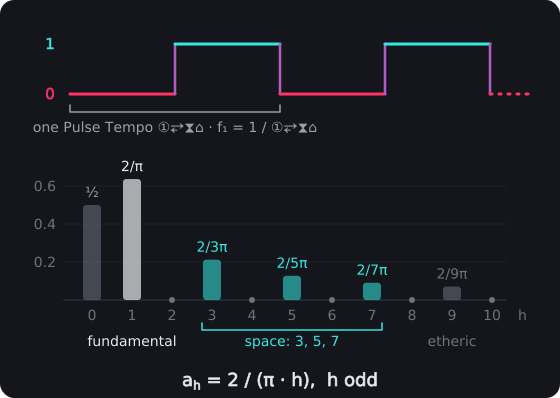
The Spectrum of the Binary Pulse. A pulse that holds 0 and 1 for half a Tempo each is a square wave: a steady half, the fundamental, and only the odd harmonics, a_h = 2 / (π · h). Its strongest overtones are 3, 5 and 7, the primes read as space; 9 is the first etheric harmonic, and the even harmonics are absent.
A Universe's Note
Universe Note Frequency G
f₁ = 1 / ①⥂⧗⌂
Dimensional analysis:
Where (from the book): f₁ [𝕋⁻¹]
[𝕋⁻¹]
[∅] ÷ [𝕋] = [𝕋⁻¹]
[𝕋⁻¹] = [𝕋⁻¹] ✓ Valid PulseCore Verified ✓
A universe sounds one over its Pulse Tempo
Where:
- f₁ [𝕋⁻¹] — the fundamental of a universe's pulse
- ①⥂⧗⌂ [𝕋] — its Local Pulse Tempo, one full 0 → 1 → 0
➢ Ours: the Pulse Tempo is the Planck time, 5.391 × 10⁻⁴⁴ s (Tiesinga et al., 2021), so f₁ = 1.855 × 10⁴³ Hz, 143.73 octaves above one cycle a second.
This is the universe's Alpha, its own first note: it sounds when its Pulsecore is sealed and the fill begins, before any layer exists. It is not the Zinf's note. The Zinf's is the Prime Pulse's (below), the first note of all, from which a universe's Alpha descends by its lineage; the two are related, as a child's note is to its ancestor's, but they are different notes.
A note moved by whole octaves keeps its name: an octave is the pulse doubling, and pitch is heard as the place within the octave. So any universe's note can be brought into hearing without changing it.
Octave Transposition G
f♪ = f₁ / 2^k
Dimensional analysis:
Where (from the book): f♪ [𝕋⁻¹], f₁ [𝕋⁻¹], k [∅]
[𝕋⁻¹]
[𝕋⁻¹] ÷ [∅]^([∅]) = [𝕋⁻¹] ÷ [∅] = [𝕋⁻¹]
[𝕋⁻¹] = [𝕋⁻¹] ✓ Valid PulseCore Verified ✓
The same note, moved by whole octaves
Where:
- f♪ [𝕋⁻¹] — the note brought into hearing
- f₁ [𝕋⁻¹] — a universe's fundamental
- k [∅] — a whole number of octaves
➢ Ours, moved down 135 octaves, sounds at 425.9 Hz: between G♯ (415.3 Hz) and A (440 Hz), 43 cents above G♯ and 57 cents below A. The Planck time is known to about one part in a hundred thousand, so the pitch is fixed to a small fraction of a cent. It is not the 432 Hz of a tuning tradition, which no law of physics sets.
The Prime Pulse's Note and the Lineage
Every universe's note comes from one first note. The Prime Pulse, ∅ → (0 ↔ 1), is the first completed pulse of the UniSphere, one Zinf cycle ℨ long, and every universe's Pulse Tempo is that cycle dilated by its level, ①⥂⧗⌂ = 2^L · f^L · ℨ (Chapter 1). So every universe's note is the Prime Pulse's note carried down its lineage.
Prime Pulse Note G
f_ℨ = 1 / ℨ
Dimensional analysis:
Where (from the book): f_ℨ [𝕋⁻¹], ℨ [𝕋]
[𝕋⁻¹]
[∅] ÷ [𝕋] = [𝕋⁻¹]
[𝕋⁻¹] = [𝕋⁻¹] ✓ Valid PulseCore Verified ✓
The first note: one over one Zinf cycle
Where:
- f_ℨ [𝕋⁻¹] — the frequency of the Prime Pulse
- ℨ [𝕋] — one Zinf cycle, 0 → 1 → 0 at the floor of the UniSphere, ≈ 2.283 × 10⁻¹⁰⁶ s
➢ f_ℨ ≈ 4.38 × 10¹⁰⁵ Hz, 350.93 octaves above one cycle a second; brought into hearing, 244.4 Hz, a B 18 cents flat.
Lineage Note G
f₁ = f_ℨ / (2 · f)^L
Dimensional analysis:
Where (from the book): f₁ [𝕋⁻¹], f_ℨ [𝕋⁻¹], f [∅], L [∅]
[𝕋⁻¹]
[𝕋⁻¹] ÷ ([∅] × [∅])^([∅]) = [𝕋⁻¹] ÷ [∅]^([∅]) = [𝕋⁻¹] ÷ [∅] = [𝕋⁻¹]
[𝕋⁻¹] = [𝕋⁻¹] ✓ Valid PulseCore Verified ✓
A universe's note is the first note carried down its lineage
Where:
- f₁ [𝕋⁻¹] — the note of a universe at level L
- f_ℨ [𝕋⁻¹] — the Prime Pulse's note
- f [∅] — the heritage factor of the lineage, 1.018 for ours
- L [∅] — the level
➢ Each level lowers the note by one octave, which keeps its name, and by the heritage factor, 1200 · log₂ f ≈ 30.9 cents for ours, which does not. Down 202 levels our lineage falls 202 octaves and 6,239 cents more, 207.2 octaves in all, from the Prime Pulse's B, 18 cents flat, to our G♯, 43 cents sharp. Within a universe its novas add exact whole-number harmonics of its note; across levels the notes are lower octaves of the first note, bent by f, so a lineage is a slow descent in pitch, 31 cents a level, around the circle of the octave.
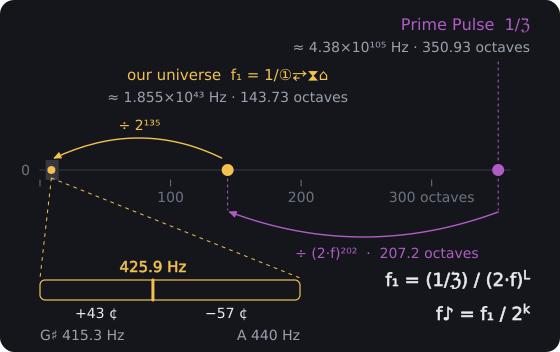
The Note of a Universe. The Prime Pulse sounds at f_ℨ = 1/ℨ ≈ 4.38 × 10¹⁰⁵ Hz; carried down 202 levels, f₁ = f_ℨ / (2 · f)ᴸ, it becomes our note, 1/①⥂⧗♁ ≈ 1.855 × 10⁴³ Hz, 207.2 octaves lower. Moved down 135 octaves, f♪ = f₁ / 2ᵏ, it sounds at 425.9 Hz, 43 cents above G♯ and 57 cents below A.
The names in this part, B and G♯ and A, and the figures in hertz, depend on the second, a human unit, and on the convention that A is 440 Hz; another unit of time would give the same notes other names. What is physical is in the ratios: the odd harmonics of the pulse, the whole-number harmonics of the novas, the octave each level descends, and the drift of the heritage factor. Read in those terms the note of a universe carries no human choice at all.
A Child's Note
A child universe takes its Tempo from its Null Well's mass, ①⥂⧗′⌂ = ①⥂⧗⌂ · (M∅ / M_P)^½ (Part 6.5; Constants of a Child Universe, Chapter 1), so its note follows from its parent's.
Child Note G
f₁′ = f₁ · (M_P / M∅)^(1/2)
Dimensional analysis:
Where (from the book): f₁′ [𝕋⁻¹], f₁ [𝕋⁻¹]
[𝕋⁻¹]
[𝕋⁻¹] × ([𝕄] ÷ [𝕄])^([∅] ÷ [∅]) = [𝕋⁻¹] × ([𝕄] ÷ [𝕄])^([∅]) = [𝕋⁻¹] × [∅]^([∅]) = [𝕋⁻¹] × [∅] = [𝕋⁻¹]
[𝕋⁻¹] = [𝕋⁻¹] ✓ Valid PulseCore Verified ✓
A heavier well gives a slower Tempo and a lower note
Where:
- f₁′ [𝕋⁻¹] — the child's fundamental
- f₁ [𝕋⁻¹] — the parent's fundamental
- M_P [𝕄] — the parent's Planck mass
- M∅ [𝕄] — the mass of the Null Well the child is born in
➢ Each lineage of universes is a sequence of notes: a well four times heavier than another seeds a child an octave lower. The pitch class of each child, its place within the octave, is set by the square root of its well's mass in Planck units.
The Alpha, the Octaves and the Chord
A universe does not stay one note, and it changes note in two ways, one before it has a body and one after.
Before space exists there is nothing to vibrate but the data itself. The Pulsecore's data doubles and doubles as it fills (the Recursive Capacity Law, Part 3.6), and a doubling is an octave: the Pulsecore climbs the Alpha's own note, octave after octave, the same note higher each time its data doubles. It begins from the data the Alpha's first Tempo carries, 4 × 4 = 16 bits, the Zinf's grain at every level; the grain is the Zinf's, the note is the universe's own.
Pulsecore Octave Ladder G
f_N = f₁ · N / (16 · ℨᵇ) [𝕋⁻¹]
Dimensional analysis:
Where (from the book): 16 [1ᵇ], f_N [𝕋⁻¹], f₁ [𝕋⁻¹], N [1ᵇ]
[𝕋⁻¹]
[𝕋⁻¹] × [1ᵇ] ÷ ([∅] × [1ᵇ]) = [𝕋⁻¹·1ᵇ] ÷ ([∅] × [1ᵇ]) = [𝕋⁻¹·1ᵇ] ÷ [1ᵇ] = [𝕋⁻¹]
[𝕋⁻¹] = [𝕋⁻¹] ✓ Valid PulseCore Verified ✓
Each doubling of the data within raises the Alpha one octave, the same note higher.
Where:
- f_N [𝕋⁻¹] – the note the Pulsecore sounds holding N bits
- f₁ [𝕋⁻¹] – the universe's Alpha, one over its Pulse Tempo
- N [1ᵇ] – the data within, (2r)² Zinf bits after r Rhythms
- 16 · ℨᵇ [1ᵇ] – the data of the first Tempo, the Zinf's grain
➢ Space is born at the Null Nova, when the data holds χ_∂ / 2 bits (the Null Nova Condition), so it sounds the Alpha 2L − 1 octaves up: at level 1 one octave, at ours 403. Space is born on the Alpha's own note.
Space Fundamental G
f_S = f₁ · χ_∂ / (32 · ℨᵇ) [𝕋⁻¹]
Dimensional analysis:
Where (from the book): 32 [1ᵇ], f_S [𝕋⁻¹], f₁ [𝕋⁻¹], χ_∂ [1ᵇ], L [∅]
[𝕋⁻¹]
[𝕋⁻¹] × [1ᵇ] ÷ ([∅] × [1ᵇ]) = [𝕋⁻¹·1ᵇ] ÷ ([∅] × [1ᵇ]) = [𝕋⁻¹·1ᵇ] ÷ [1ᵇ] = [𝕋⁻¹]
[𝕋⁻¹] = [𝕋⁻¹] ✓ Valid PulseCore Verified ✓
f_S = f₁ · 2^(2L − 1) [𝕋⁻¹]
Dimensional analysis:
Where (from the book): 32 [1ᵇ], f_S [𝕋⁻¹], f₁ [𝕋⁻¹], χ_∂ [1ᵇ], L [∅]
[𝕋⁻¹]
[𝕋⁻¹] × [∅]^([∅] × [∅] - [∅]) = [𝕋⁻¹] × [∅]^([∅] - [∅]) = [𝕋⁻¹] × [∅]^([∅]) = [𝕋⁻¹] × [∅] = [𝕋⁻¹]
[𝕋⁻¹] = [𝕋⁻¹] ✓ Valid PulseCore Verified ✓
Space sounds the Alpha 2L − 1 octaves higher, and from then on it is the fundamental every layer sounds over.
Where:
- f_S [𝕋⁻¹] – the note of space, Harmonic 1
- f₁ [𝕋⁻¹] – the universe's Alpha
- χ_∂ [1ᵇ] – the Bifold's holographic capacity, 16 · 4^L bits
- 32 · ℨᵇ [1ᵇ] – twice the first Tempo's data, a bit and its null for each
- L [∅] – the universe's level
➢ With space there is a body, and a body sounds overtones: the modes of a vibrating thing are the whole multiples of its fundamental (Fourier, 1822; Helmholtz, 1863), and there are none before there is something to vibrate. So the Pulsecore climbs in octaves, and space, once made, is the instrument: every layer after it sounds a whole-number overtone of the note of space.
Layer Harmonic G
f_h = h · f_S [𝕋⁻¹]
Dimensional analysis:
Where (from the book): f_h [𝕋⁻¹], h [∅], f_S [𝕋⁻¹]
[𝕋⁻¹]
[∅] × [𝕋⁻¹] = [𝕋⁻¹]
[𝕋⁻¹] = [𝕋⁻¹] ✓ Valid PulseCore Verified ✓
Harmonic h, the h-th layer, sounds h times the note of space.
Where:
- f_h [𝕋⁻¹] – the note of Harmonic h
- h [∅] – the harmonic's number, the layer: 1 space, 2 the data lattice, 3 the physical, 4 spacetime and on
- f_S [𝕋⁻¹] – the note of space
➢ The two rules meet at the Data Nova. The data lattice, Harmonic 2, sounds 2 · f_S, the octave of space, the first overtone of any string; and it is also one more doubling of the data, from χ_∂ / 2 bits at the Null Nova to χ_∂ at the Data Nova, so the octave ladder gives the same note. The physical, Harmonic 3, sounds 3 · f_S, the twelfth, an octave and a fifth: the first note that is not the Alpha's, and the first layer that is a new kind of thing, matter, where space and the data lattice are the Alpha's own note at its octaves. Harmonic 4, the first overtone, is the double octave, the Alpha's note again, which is why it founds nothing new; and the Harmonic Novas after it fill the series as the life closes. Since f_S is the Alpha moved by whole octaves, every ratio between the layers is the ratio of their harmonic numbers, and the reading of the dimensions in Part 4.8 is unchanged. When the novas arrive is Data Harmonics' rule (Part 3.6); what they sound is this one.
What the note is, and what it is not, should be plain. No instrument hears a universe; its note is the frequency of its pulse, read as music. Its physical content is in the spectrum, the odd harmonics of the pulse and the whole harmonics of its layers, and that is what Part 4.8 reads as dimensions. The note itself is that structure made audible.
Links to Binary Pulse Theory
- Chapter 1: the Pulse Tempo and the Pulse Rhythm, 0 → 1 → 0 and its half; the Constants of a Child Universe.
- Part 3.6: Data Harmonics numbers the layers as harmonics and sets when they arrive; the Recursive Capacity Law doubles the data, the octaves of the Pulsecore; the Null Nova Condition sets where space sounds.
- Part 4.8: the odd harmonics of the pulse and the prime axes of the dimensions.
- Part 6.5: a child's Tempo from its well's mass, and so its note.