Chapter 6 · Section 8
The Merger Compression Factor and PD Variability
The physical picture of Pulse Diameter Variability and merger-origin Universes is set out in Part 2.8; here we give its formal structure. A well that merges many times seeds one child all the same, one horizon being one record, and its record is a mosaic: each progenitor a domain of the child by its share of the merged horizon's area, and the area each merger adds a domain written new (Merger Domains, Part 3.6); the record reaches the child's Pulsecore as a stream with bursts, in the order the well lived it but outside the child's time (Pulsecore Stream, Part 3.6).
PD Variability Definition and Harmonic Relations
By studying the PD Variability Definition and Harmonic Relations, we can understand how pulse diameter scaling depends on recursive depth and progenitor Null Well characteristics, revealing the computational mechanisms underlying temporal quantization inheritance across cosmic generation cycles. The compression factors for merger origins demonstrate how binary Null Well coalescence events determine relativistic compression through mass, spin, and alignment contributions, with explicit functional forms showing how these effects contribute independently to temporal quantum compression through separable mathematical relationships.
Null Well class effects on PD₀ reveal how different progenitor configurations systematically influence pulse diameter scaling and harmonic signatures in emergent universes, from Schwarzschild baselines through progressively compressed Kerr geometries to complex multi-harmonic binary merger signatures. This framework connects gravitational collapse geometry directly to inherited temporal quantization properties, demonstrating how the mathematical structure of relativistic compression factor determination enables systematic inheritance of temporal characteristics based on progenitor Null Well properties and merger dynamics across cosmic generation cycles.
For a Universe of Recursion level n
PD(n) = ☫⊕ × 2ⁿ × f₀ⁿ × F(∅▤, spin, ⋎) [𝕃]
Where:
- PD(n) [𝕃] - pulse diameter at recursion level n
- ☫⊕ [𝕃] - Zinf Diameter, 𝒞→·ℨ/2 ≈ 3.423 × 10⁻⁹⁸ m (Part 1.6)
- 2 [∅] - binary scaling factor
- n [∅] - recursion level from prime domain
- f₀ [∅] - baseline heritage per level of an uncompressed lineage
- f [∅] - net null-well heritage per level (≈ 1.018 for our universe), mergers included
- ^ - exponentiation operator
- F(...) [∅] - Relativistic Compression Factor determined by progenitor Null Well properties
- ∅▤ [∅] - Null Well classification parameter
- spin [∅] - angular momentum parameter
- ⋎ [∅] - binary merger characteristics
- [∅] - quantities without physical units, pure numerical ratios or mathematical constants
➢ Pulse diameter scaling with recursive depth and progenitor characteristics, tracing temporal quantization origins through binary exponential scaling and relativistic compression factors.
Baseline Cases:
- Schwarzschild Origin: C = 1.0000 (isotropic baseline)
- Moderate Kerr Origin: 0.98 < C < 1.00 (mild compression)
- Extreme Kerr Origin: 0.95 < C ≤ 0.98 (high spin compression)
- Binary Merger Origin: 0.937 ≤ C < 0.95 (double harmonic injection)
Where:
- C [∅] - relativistic compression factor
- 1.0000 [∅] - isotropic baseline compression value
- 0.98 [∅] - moderate Kerr compression threshold
- 1.00 [∅] - upper moderate Kerr compression limit
- 0.95 [∅] - extreme Kerr compression threshold
- 0.937 [∅] - binary merger compression threshold, the Kerr floor (Part 6.9)
- < - inequality operator, less than
- ≤ - inequality operator, less than or equal to
- [∅] - quantities without physical units, pure numerical ratios or mathematical constants
Dimensional analysis: [∅] = [∅], [∅] < [∅] < [∅], [∅] < [∅] ≤ [∅], [∅] ≤ [∅] < [∅] ✓ The baseline cases are dimensionally consistent as dimensionless compression factor ranges.
➢ Classification scheme for relativistic compression factors based on progenitor Null Well characteristics, demonstrating systematic inheritance of temporal scaling properties through cosmic generation mechanisms.
Compression Factor for Merger Origins
F(M₁, M₂, a₁, a₂, θ⋎) = g⚛(M₁ + M₂) × s↻(a₁, a₂) × h⇉(θ⋎) [∅]
Where:
- F(M₁, M₂, a₁, a₂, θ⋎) [∅] - compression factor function for merger origins
- M₁ [𝕄] - first progenitor mass
- M₂ [𝕄] - second progenitor mass
- a₁ [∅] - first progenitor dimensionless spin parameter
- a₂ [∅] - second progenitor dimensionless spin parameter
- θ⋎ [∅] - Spin Axis Orientation difference at coalescence
- g⚛(M₁ + M₂) [∅] - Mass-Sum Curvature Term
- s↻(a₁, a₂) [∅] - Spin Injection Term
- h⇉(θ⋎) [∅] - Spin-Axis Alignment Factor
- 0 [∅] - minimum spin parameter value
- ≤ - inequality operator, less than or equal to
- 1 [∅] - maximum spin parameter value
- [∅] - quantities without physical units, pure numerical ratios or mathematical constants
Dimensional analysis:
Where (from the book): 0 [∅], 1 [∅], F(M₁, M₂, a₁, a₂, θ⋎) [∅], g⚛(M₁ + M₂) [∅], s↻(a₁, a₂) [∅], [∅] [∅]
[∅]
[∅] × [∅] × [∅] = [∅] × [∅] = [∅]
[∅] = [∅] ✓ Valid PulseCore Verified ✓
➢ Multi-factor compression from merger dynamics shaping temporal quantum determination through mass curvature effects, spin injection mechanisms, and spin-axis alignment contributions.
Explicit Functional Forms
g⚛(M⊚) ≡ 1 [∅]
Dimensional analysis:
Where (from the book): g⚛(M⊚) [∅], M⊚ [𝕄], ^(1/6) [∅], s↻(a₁, [∅], κ↻ [∅], ^(1/2) [∅], h⇉(θ) [∅], κ⇉ [∅], θ [∅], [∅] [∅]
[∅]
([𝕄] ÷ [𝕄])^([∅] ÷ [∅]) = ([𝕄] ÷ [𝕄])^([∅]) = [∅]^([∅]) = [∅]
[∅] = [∅] ✓ Valid PulseCore Verified ✓
s↻(a₁, a₂) = 1 - κ↻ · (a₁² + a₂²)^(1/2) [∅]
Dimensional analysis:
Where (from the book): g⚛(M⊚) [∅], M⊚ [𝕄], s↻(a₁, a₂) [∅], κ↻ [∅], ^(1/2) [∅], h⇉(θ) [∅], κ⇉ [∅], θ [∅], [∅] [∅]
[∅]
[∅] - [∅] × ([∅] + [∅])^([∅] ÷ [∅]) = [∅] - [∅] × ([∅] + [∅])^([∅]) = [∅] - [∅] × [∅]^([∅]) = [∅] - [∅] × [∅] = [∅] - [∅] = [∅]
[∅] = [∅] ✓ Valid PulseCore Verified ✓
h⇉(θ) = 1 - κ⇉ · sin²(θ/2) [∅]
Where:
- g⚛(M⊚) [∅] - Mass-Sum Curvature Term, set to 1: spin is the sole source of compression (Part 6.9)
- M⊚ [𝕄] - total merger mass
- s↻(a₁, a₂) [∅] - Spin Injection Term
- κ↻ [∅] - Coupling Parameters for spin effects
- a₁ [∅] - first progenitor dimensionless spin parameter
- a₂ [∅] - second progenitor dimensionless spin parameter
- ^(1/2) [∅] - square root exponent
- h⇉(θ) [∅] - Spin-Axis Alignment Factor
- κ⇉ [∅] - Coupling Parameters for alignment effects
- sin² - squared sine function
- θ [∅] - spin axis orientation difference
- [∅] - quantities without physical units, pure numerical ratios or mathematical constants
Dimensional analysis:
Where (from the book): g⚛(M⊚) [∅], M⊚ [𝕄], ^(1/6) [∅], s↻(a₁, [∅], κ↻ [∅], ^(1/2) [∅], h⇉(θ) [∅], κ⇉ [∅], θ [∅], [∅] [∅]
[∅]
[∅] - [∅] × [∅]([∅] ÷ [∅]) = [∅] - [∅] × [∅]([∅]) = [∅] - [∅] × [∅] = [∅] - [∅] = [∅]
[∅] = [∅] ✓ Valid PulseCore Verified ✓
➢ Separate contributions from mass, spin, and alignment effects determining temporal quantum compression through independent scaling relationships that combine multiplicatively to produce total compression factors.
Null Well Class Effects on PD₀
Class | Geometry & Spin | PD₀ Scaling Effect | Harmonic Signature |
|---|---|---|---|
Schwarzschild | Non-rotating | Baseline | Isotropic |
Kerr | Rotating | PD₀ shortened | Mild anisotropy |
Extreme Kerr | Near-max spin | PD₀ near minimum | Strong anisotropy |
Binary Merger | Two Kerr-type merging | PD₀ compressed via mass-energy sum and spin injection | Multi-harmonic offsets, anisotropic early expansion |
Where:
- PD₀ [𝕃] - baseline pulse diameter in emergent universe
- Schwarzschild - non-rotating Null Well classification
- Kerr - rotating Null Well classification
- Extreme Kerr - near-maximum spin Null Well classification
- Binary Merger - two merging Null Well classification
- Baseline - reference scaling factor for comparison
- Isotropic - uniform directional harmonic signature
- Anisotropy - directional-dependent harmonic signature
- Multi-harmonic - multiple frequency harmonic signature
- [∅] - quantities without physical units, pure numerical ratios or mathematical constants
Dimensional analysis: [𝕃] scaling effects maintain dimensional consistency across all Null Well classifications ✓ The pulse diameter effects are dimensionally consistent for length scaling modifications.
The PD Variability and Harmonic Relations framework demonstrates how Binary Pulse Theory connects temporal quantization to cosmic heritage through exponential scaling laws and relativistic compression factors, with merger dynamics incorporating gravitational wave effects through complex interplay of progenitor masses, spin parameters, and orbital alignment configurations.
The mathematical structure decomposes merger dynamics into separable contributions—mass effects following inverse sixth-root scaling, spin effects lowering the compression factor through root-sum-square coupling, and alignment effects modulated by trigonometric orientation dependencies—enabling systematic classification from Schwarzschild baselines through Kerr geometries to complex multi-harmonic binary merger signatures that directly connect gravitational collapse geometry to inherited temporal quantization characteristics.
Null Well Collision Channels and Pulse Diameter Impacts
Within the BPT framework, realized Pulse Diameter (PD₀) depends strongly on Collision Channel that produced the Null Well. Different progenitor types inject distinct amounts of spin, mass asymmetry, and gravitational wave interference into Prime Pulse Bifurcation, altering compression factors.
By examining the Null Well Collision Channels and Pulse Diameter Impacts, we can understand how different formation mechanisms systematically determine compression factors and harmonic signatures, revealing the relationship between gravitational wave merger dynamics and inherited temporal quantization properties across diverse cosmic environments.
Null Well Collision Channel Classification
Collision Channel | Description | Predicted C(⇌) Range | PD Shift vs. Baseline | Harmonic Signature |
|---|---|---|---|---|
Stellar Core-Collapse + Companion Collision | Massive star collapses during collision with companion | 0.97 – 0.99 | Mild compression | Slight anisotropy, early structure bias |
NS–NS Merger | Two neutron stars merge, exceeding degeneracy limit | 0.96 – 0.98 | Moderate compression | Symmetric GW interference, minor harmonic offset |
NS–Null Well Merger | Neutron star tidally disrupted before Null Well absorption | 0.94 – 0.97 | Significant compression | Directional harmonic bias along disruption axis |
Kerr–Kerr Merger | Two spinning Null Wells merge, co-rotating or partially aligned | 0.92 – 0.95 | Strong compression | Multi-harmonic offset, anisotropic expansion |
Kerr–Schwarzschild Merger | Spin from Kerr dominates | 0.94 – 0.97 | Significant compression | Mild anisotropy, single-offset pattern |
Extreme Kerr–Kerr Merger | Both Null Wells near-max spin | 0.937 – 0.94 | Extreme compression | High anisotropy, dense harmonic interference |
Multi-Body Mergers | Hierarchical repeated mergers in dense environment | 0.91 – 0.95 | Strong compression | Layered harmonic profiles from spin history |
Direct Gas Cloud Collapse | Early-Universe gas collision collapses directly to SMBH | 0.98 – 1.00 | Minimal compression | Low-spin isotropic harmonic pattern |
Where:
- PD₀ [𝕃] - realized pulse diameter in emergent universe
- C(⇌) [∅] - compression factor based on formation channel
- [∅] - quantities without physical units, pure numerical ratios or mathematical constants
Dimensional analysis: [𝕃] scaling effects and [∅] compression factors maintain dimensional consistency across all collision channels ✓ The collision channel classifications are dimensionally consistent for compression factor ranges.
The Null Well Collision Channels framework reveals how Binary Pulse Theory connects diverse formation mechanisms to systematic temporal inheritance patterns, with compression factors ranging from near-baseline direct collapse scenarios to extreme compression in spinning binary mergers, enabling predictive classification of emergent universe characteristics based on progenitor collision channel identification.
Expanded Origin Compression Factor Equation
For merger-driven origins, by studying the Expanded Origin Compression and Merger Dynamics, we can understand how merger-driven origins determine compression factors through comprehensive mathematical modeling of mass, spin, and alignment contributions, enabling precise universe classification based on cosmic heritage and progenitor characteristics.
Origin Compression Factor
C(⇌) = F(M₁, M₂, a₁, a₂, θ⋎) [∅]
Dimensional analysis:
Where (from the book): F(M₁, M₂, a₁, a₂, θ⋎) [∅], ⋎ [∅]
[∅]
[∅]
[∅] = [∅] ✓ Valid PulseCore Verified ✓
Merger Dynamics Function
F(M₁, M₂, a₁, a₂, θ⋎) = g⚛(M₁ + M₂) × s↻(a₁, a₂) × h⇉(θ⋎) [∅]
Where:
- C(⇌) [∅] - compression factor based on formation channel
- F(M₁, M₂, a₁, a₂, θ⋎) [∅] - comprehensive merger dynamics function
- M₁ [𝕄] - first progenitor mass
- M₂ [𝕄] - second progenitor mass
- a₁ [∅] - first progenitor dimensionless spin parameter
- a₂ [∅] - second progenitor dimensionless spin parameter
- θ⋎ [∅] - spin axis orientation difference at coalescence
- g⚛(M₁ + M₂) [∅] - mass-sum curvature term
- s↻(a₁, a₂) [∅] - spin injection term
- h⇉(θ⋎) [∅] - spin-axis alignment factor
- [∅] - quantities without physical units, pure numerical ratios or mathematical constants
➢ Comprehensive compression factor from merger dynamics enabling precise Universe classification by cosmic heritage through systematic mathematical modeling of progenitor characteristics and coalescence parameters.
The Expanded Origin Compression Factor Equation framework demonstrates how Binary Pulse Theory provides comprehensive mathematical modeling for merger-driven universe origins, with compression factors determined by the multiplicative combination of mass curvature effects, spin injection mechanisms, and alignment dependencies that enable precise classification of emergent universes based on their gravitational wave merger heritage.
Harmonic Scaling Framework for Merger-Origin Universes
Through examining the Harmonic Scaling Framework for Merger-Origin Universes, we can understand how local Planck time modifications in merger-origin domains create accelerated structure formation through compression-induced temporal scaling, revealing the observational signatures that distinguish merger heritage from baseline cosmic evolution.
Local Planck Time Relation
①⥂⧗⌂ = 2 × (☫⊕/𝒞→) × 2ⁿ × f₀ⁿ × C(⇌) [𝕋]
Where:
- ①⥂⧗⌂ [𝕋] - Local Pulse Tempo in merger-origin domain
- ☫⊕ [𝕃] - Zinf Diameter, 𝒞→·ℨ/2 ≈ 3.423 × 10⁻⁹⁸ m (Part 1.6)
- 𝒞→ [𝕃·𝕋⁻¹] - speed of light
- n [∅] - recursion level from prime domain
- f₀ [∅] - baseline heritage per level of an uncompressed lineage
- f [∅] - net null-well heritage per level (≈ 1.018 for our universe), mergers included
- C(⇌) [∅] - compression factor based on formation channel
- [∅] - quantities without physical units, pure numerical ratios or mathematical constants
Dimensional analysis:
Where (from the book): Z [𝕃], n [∅], [∅] [∅]
[𝕋]
[∅] × ([𝕃] ÷ [𝕃·𝕋⁻¹]) × [∅]ⁿ × [∅]ⁿ × [∅] = [∅] × [𝕋] × [∅]ⁿ × [∅]ⁿ × [∅] = [𝕋] × [∅]ⁿ × [∅]ⁿ × [∅] = [𝕋] × [∅] × [∅]ⁿ × [∅] = [𝕋] × [∅]ⁿ × [∅] = [𝕋] × [∅] × [∅] = [𝕋] × [∅] = [𝕋]
[𝕋] = [𝕋] ✓ Valid PulseCore Verified ✓
➢ For merger-origin domains: C(⇌) < 1 → ①⥂⧗⌂ shorter → higher maximum operations/sec → accelerated structure formation through compression-induced temporal acceleration enabling enhanced cosmic evolution rates.
Harmonic Signature Traits:
- Multi-Harmonic Offsets in CMB anisotropies
The Harmonic Scaling Framework demonstrates how Binary Pulse Theory predicts systematic deviations in merger-origin universes through compressed temporal scaling, with observational signatures including multi-harmonic CMB offsets, reduced spectral indices, spin-aligned large-scale structure, and elevated early galaxy formation rates that provide testable predictions for distinguishing cosmic heritage through precision cosmological observations.
Harmonic Scaling Impact
By analyzing the Harmonic Scaling Impact for our Universe at recursion level 202, we can understand how measured cosmic properties reveal compression factors consistent with high-spin binary Kerr progenitors, suggesting merger-origin temporal quantization inheritance in our observable cosmos.
Given PD(202) for Our Universe
PD(202) = ☫⊕ × 2²⁰² × f₀²⁰² × C(⇌) [𝕃]
Where:
- PD(202) [𝕃] - pulse diameter at recursion level 202 for our Universe
- ☫⊕ [𝕃] - Zinf Diameter, 𝒞→·ℨ/2 ≈ 3.423 × 10⁻⁹⁸ m (Part 1.6)
- 202 [∅] - recursion level for our Universe
- f₀²⁰² [∅] - baseline heritage over 202 levels (≈ 39.2, Part 6.8), the reading of one generation a level; a lineage carries H = ∏ f₀⟪C⟫ over the generations it really had (Part 2.8, Level and Lineage Clock)
- C(⇌) [∅] - compression factor for our Universe, ≈ 0.937, a Kerr–Kerr merger at the Thorne limit by the spin law of Part 6.9, just above its Kerr floor
- [∅] - quantities without physical units, pure numerical ratios or mathematical constants
Dimensional analysis:
Where (from the book): 202 [∅], PD(202) [𝕃], Z [𝕃], F(⋎) [∅], 0.92 [∅], 0.94 [∅], [∅] [∅]
[𝕃]
[𝕃] × [∅] × [∅] × [∅] = [𝕃] × [∅] × [∅] = [𝕃] × [∅] = [𝕃]
[𝕃] = [𝕃] ✓ Valid PulseCore Verified ✓
➢ The working hypothesis sets C(⇌) ≈ 0.937, a Kerr–Kerr merger at the Thorne limit by the spin law of Part 6.9, consistent with high-spin binary Kerr progenitors, resulting in ~6.3% harmonic compression from baseline (2²⁰² × 39.2 × 0.937 ≈ 2.37 × 10⁶² Zinf units) — consistent with a merger-origin cosmic heritage.
The Harmonic Scaling Impact framework demonstrates how Binary Pulse Theory proposes an estimate of our Universe's cosmic heritage through pulse diameter measurements, with compression factors indicating high-spin binary Kerr merger origins that produce systematic temporal acceleration effects observable in cosmic structure formation rates and harmonic signatures.
Cosmological Framework and Temporal Genesis
Merger-origin null wells represent Variable Genesis Conditions within BPT framework. Becker, Becker, and Schwarz's higher-dimensional brane-collision frameworks (Becker et al., 2007) parallel this, where initial bulk collision conditions dictate long-term fundamental constant scaling.
Compression factor C(⇌) is conserved across entire harmonic progression, meaning all descendant constants and causal thresholds are shifted from baseline values, altering:
- Light speed scaling in local domains
- Effective gravitational constant geometry
- Maximum quantum information processing rate
- Observable power spectrum of primordial fluctuation
Our Estimated Origin Class and Recursive Placement
BPT's working hypothesis, set at the Kerr floor (Part 6.9), places our origin at a high-spin binary Kerr–Kerr merger; the test is a fit of multi-harmonic CMB offsets, large-scale filament alignment and inferred Planck time compression against that channel. Compression factor of a Kerr–Kerr merger at the Thorne limit, C(⇌) = 1 − κ·0.960² ≈ 0.937, just above the Kerr floor, implies Extreme-Compression Null Well Origin, consistent with near-maximal spin parameters (a₁, a₂ → 1) and low spin-axis misalignment (θ⋎ ≲ 15°).
In BPT recursive topology, such a compression factor places our domain within the Merger-Compressed Branch: the branch of the lineage compressed by one merger, at our origin (its level L = 202 counts doublings, not generations or mergers). That single compression C(⇌) is inherited by every level after it, so our entire causal lattice operates with ≈ 6.3% harmonic shortening (1 − 0.937 = 0.063) established at origin.
Recursive Relation
If prime domain PD₀ = Z, every level carries the baseline heritage f₀ of an uncompressed (Schwarzschild) lineage, and each merger applies a compression constant on top. The merger compressions are part of the heritage f of Chapter 2: fⁿ = f₀ⁿ × ∏Cᵢ.
Compression Constant
PD(n) = ☫⊕ × 2ⁿ × f₀ⁿ × ∏ᵢ₌₁ᵍ Cᵢ = ☫⊕ × 2ⁿ × fⁿ [𝕃]
Where:
- PD(n) [𝕃] - pulse diameter at recursion level n
- ☫⊕ [𝕃] - Zinf Diameter, 𝒞→·ℨ/2 ≈ 3.423 × 10⁻⁹⁸ m (Part 1.6)
- n [∅] - recursion level from prime domain
- f₀ [∅] - baseline heritage per level of an uncompressed lineage
- f [∅] - net null-well heritage per level (≈ 1.018 for our universe), mergers included
- ∏ᵢ₌₁ᵍ - product operator from i=1 to g
- g [∅] - number of merger events in lineage
- Cᵢ [∅] - compression factor from each genesis event
- i [∅] - index variable for merger events
- [∅] - quantities without physical units, pure numerical ratios or mathematical constants
Dimensional analysis:
Where (from the book): n [∅], f [∅], g [∅], Cᵢ [∅], i [∅], [∅] [∅]
Read dimensionally: PD(n) = ☫⊕ × 2ⁿ × f₀ⁿ × prod(Cᵢ) = ☫⊕ × 2ⁿ × fⁿ
[𝕃]
[𝕃] × [∅]ⁿ × [∅]ⁿ × prod([∅]) = [𝕃] × [∅] × [∅]ⁿ × prod([∅]) = [𝕃] × [∅]ⁿ × prod([∅]) = [𝕃] × [∅] × prod([∅]) = [𝕃] × prod([∅]) = [𝕃] × [∅] = [𝕃]
[𝕃] × [∅]ⁿ × [∅]ⁿ = [𝕃] × [∅] × [∅]ⁿ = [𝕃] × [∅]ⁿ = [𝕃] × [∅] = [𝕃]
[𝕃] = [𝕃] = [𝕃] ✓ Valid PulseCore Verified ✓
➢ Cumulative compression across multiple generations, building cosmic heritage through multiplicative accumulation of merger-induced temporal compression effects across extended cosmic lineages.
For Our Universe
g = 1, C₁ ≈ 0.937 → ∏Cᵢ = C₁ ≈ 0.937 → PD ≈ Z × 2²⁰² × f₀²⁰² × 0.937 = Z × 2²⁰² × f²⁰² → Net compression from baseline ~6.3%
Where:
- g [∅] - number of merger events in our Universe's lineage, equal to 1
- C₁ [∅] - compression factor of the one merger (genesis) event, a Kerr–Kerr merger at the Thorne limit, 1 − κ·0.960² ≈ 0.93732 by the spin law of Part 6.9, ≈ 0.937
- PD(n) [𝕃] - pulse diameter for our Universe
- ☫⊕ [𝕃] - Zinf Diameter, 𝒞→·ℨ/2 ≈ 3.423 × 10⁻⁹⁸ m (Part 1.6)
- 202 [∅] - recursion level for our Universe
- ∏Cᵢ = C₁ [∅] - with one merger the product is the single compression factor (≈ 0.937)
- f²⁰² ≈ 36.7 [∅] - net heritage of our lineage (f ≈ 1.018, Chapter 2)
- f₀²⁰² = 36.7 / 0.937 ≈ 39.2 [∅] - baseline heritage the lineage would have carried without the merger (f₀ ≈ 1.01833)
- 6.3% [∅] - net compression percentage from baseline
- [∅] - quantities without physical units, pure numerical ratios or mathematical constants
➢ Our Universe exhibits approximately 6.3% net compression from baseline through a single merger event, giving a quantitative estimate of cosmic heritage through cumulative temporal compression effects.
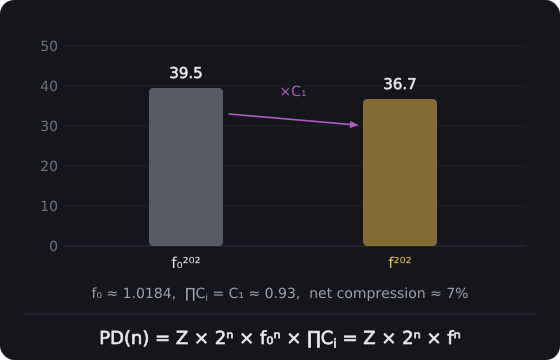
Merger Compression of Our Lineage. One merger, with C₁ ≈ 0.937, multiplies the baseline heritage f₀²⁰² ≈ 39.2 by ∏Cᵢ = C₁ ≈ 0.937, leaving the net heritage f²⁰² ≈ 36.7 with f = 1.018: a net compression of about 6.3%, PD(n) = ☫⊕ × 2ⁿ × f₀ⁿ × ∏Cᵢ = ☫⊕ × 2ⁿ × fⁿ.
Our Universe's Collision Channel - High-spin binary Kerr–Kerr merger:
- Compression factor: ≈ 0.937, a Kerr–Kerr merger at the Thorne limit, just above the Kerr floor (extreme compression)
Observational Indicators of Merger-Origin Universe
- Spin-Axis Bias in Structure: Spin-axis bias in structure orientation, with derived constants fixed across our universe (Part 2.8)
Clues to Our Parent Universe Type
Observable in Our Universe | What It Suggests About Parent Universe |
|---|---|
Compression Factor (≈ 0.937) | |
CMB Harmonic Offsets | |
Early Structure Formation | Strong early connectivity suggests the parent's merger shortened our local Planck time |
Large-Scale Filament Orientation | Persistent alignment across generations implies recursive conservation of dominant spin axis |
6.8 Testable Predictions
The predictions this part shares with Chapter 2 are listed in Part 2.8.
- Spin-Axis Bias in Structure: Spin-axis bias in structure orientation, with derived constants fixed across our universe (Part 2.8), testable through large-scale structure alignment and spectroscopy finding no regional variation.
If confirmed, these predictions would indicate that:
- Reality's temporal foundations have measurable astrophysical fingerprints