Chapter 6 · Section 9
Spin Inheritance and the Progenitor Axis
What if the one property our Universe could not have produced for itself is the very one that makes it a system rather than a blob? Part 1.6, Z.11 established that a single pulse falls short of spin-½ by a factor of s²/2, roughly 2.787×10¹²⁴. A pulse cannot carry spin. The Genesis Prime Pulse therefore cannot have generated the angular momentum our Universe displays — it can only have inherited it, and the only thing on the far side of a null well is the merger that made the well.
Part 6.8 gave the Origin Compression Factor its parameters, C(⇌) = F(M₁, M₂, a₁, a₂, θ⋎), but left the spin injection term s↻(a₁, a₂) and the alignment factor h⇉(θ⋎) as named placeholders. This section closes both. Closing them turns the collision-channel classification into a measurement: from C(⇌) we can read back the spin of the merger that made us.
Progenitor Angular Momentum Budget
J⊚ = J⥀ + J₁ + J₂
Dimensional analysis:
Where (from the book): J⊚ [𝕄·𝕃²·𝕋⁻¹], J⥀ [𝕄·𝕃²·𝕋⁻¹], Jᵢ [𝕄·𝕃²·𝕋⁻¹], aᵢ [∅], Mᵢ [𝕄]
[𝕄·𝕃²·𝕋⁻¹]
[𝕄·𝕃²·𝕋⁻¹] + [𝕄·𝕃²·𝕋⁻¹] + [𝕄·𝕃²·𝕋⁻¹] = [𝕄·𝕃²·𝕋⁻¹] + [𝕄·𝕃²·𝕋⁻¹] = [𝕄·𝕃²·𝕋⁻¹]
[𝕄·𝕃²·𝕋⁻¹] = [𝕄·𝕃²·𝕋⁻¹] ✓ Valid PulseCore Verified ✓
Three contributions, added as vectors, not magnitudes
Where:
- J⊚ [𝕄·𝕃²·𝕋⁻¹] — total angular momentum presented to the null well at coalescence
- J⥀ [𝕄·𝕃²·𝕋⁻¹] — orbital angular momentum of the binary at the last stable orbit
- Jᵢ = aᵢ G Mᵢ² / c [𝕄·𝕃²·𝕋⁻¹] — spin angular momentum of progenitor i
- aᵢ [∅] — dimensionless spin parameter of progenitor i, 0 ≤ aᵢ ≤ 1 (6.8)
- Mᵢ [𝕄] — progenitor mass (6.8)
- θ⋎ [∅] — spin-axis orientation difference at coalescence (6.8)
➢ The budget is a vector sum, which is the whole reason θ⋎ appears in 6.8 at all. Two counter-rotating progenitors bring the same angular momentum magnitudes and hand over far less than two co-rotating ones. Note that this is mechanical angular momentum throughout — dimension [𝕄·𝕃²·𝕋⁻¹], the ℨJ of Part 1.6, Z.11, carrying no 𝔸 and no ℨ. Nothing here is spin yet. 𝔸 (action) and ↁ (data) are BPT base dimensions (Part 1.7).
Inherited Spin Parameter
a_f = | ℓ·η·n̂_L + a₁(M₁/M_f)²·n̂₁ + a₂(M₂/M_f)²·n̂₂ |
The remnant spin our null well was born holding
Where:
- a_f [∅] — dimensionless spin of the merger remnant, capped at the Kerr bound
- ℓ [∅] — the orbital term: the binary's angular momentum at its last stable orbit, less what the gravitational waves carry away, in units of G·M₁M₂/𝒞→, by general relativity's fit (Rezzolla et al. 2008): ℓ = 2√3 + t₂η + t₃η² + (s₅η + t₀ + 2)(a₁cos β + a₂q²cos γ)/(1 + q²) + s₄(a₁² + a₂²q⁴ + 2a₁a₂q²cos α)/(1 + q²)², with s₄ = −0.1229, s₅ = 0.4537, t₀ = −2.8904, t₂ = −3.5171, t₃ = 2.5763, q = M₂/M₁ ≤ 1, α the angle between the spins and β, γ each spin's to the orbit (θ⋎, θ⋎/2, θ⋎/2 here); ≈ 2.746 for two wells with no spin
- η = M₁M₂/M_f² [∅] — symmetric mass ratio, maximal at ¼ for equal masses
- M_f = M₁ + M₂ [𝕄] — remnant mass, neglecting radiated mass-energy
- n̂_L, n̂₁, n̂₂ [∅] — unit vectors along the orbital and the two spin axes, separated by θ⋎
Derivation: divide each contribution of J⊚ by G M_f²/c, which is the angular momentum of an extremal Kerr well of the remnant mass. Each term becomes dimensionless and the sum is the remnant spin parameter directly. The mass-squared weighting is why component spins contribute weakly and the orbit dominates: at equal masses each spin enters at (½)² = ¼ of its value while the orbital term enters at full strength.
Calibration: ℓ is not fitted here; it is general relativity's, the fit of Rezzolla and colleagues (2008) to numerical-relativity mergers. For an equal-mass non-spinning merger η = ¼, a₁ = a₂ = 0 and ℓ ≈ 2.746, so the remnant spins at 0.686. ℓ shrinks as the progenitors' spins grow and align, for their last stable orbit moves in and the waves carry more away: two equal wells each at 0.686, aligned, leave 0.882, not the 1.03 a fixed ℓ would give, and no merger leaves more than about 0.96, two wells at the Thorne limit. A well's own spin reaches 0.998 only by accretion. (Until 17 November 2026 ℓ was held at its no-spin value, ℓ̃ = 2.744, which capped every merger of spinning wells at 0.998.)
➢ Most of what our Universe inherited came from the orbit, not from the progenitors' own rotation. Two non-spinning Null Wells still produce a remnant at a_f ≈ 0.69, because the binary's orbital angular momentum has nowhere else to go. Spin is handed down chiefly as the memory of a dance, not of the dancers.
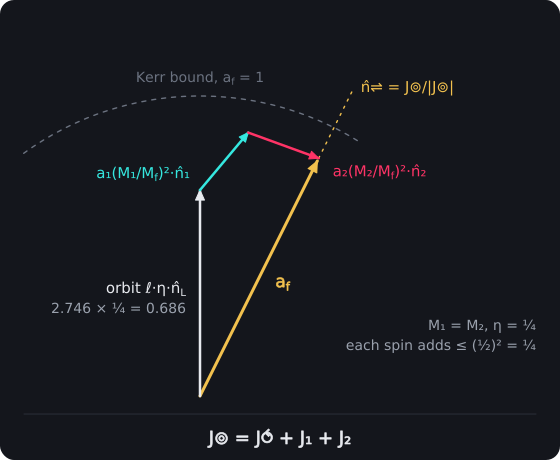
The Inherited Spin Budget. The remnant spin a_f is the length of a vector sum, J⊚ = J⥀ + J₁ + J₂. For equal masses with no spin the orbital term ℓ·η ≈ 2.746 × ¼ = 0.686 dominates and each progenitor spin adds at most ¼; the direction of the sum, n̂⇌ = J⊚/|J⊚|, is the new universe's preferred axis. The spin orientations drawn are illustrative.
Spin Injection and Alignment in Closed Form
s↻(a₁, a₂) × h⇉(θ⋎) = 1 − κ·a_f²
Dimensional analysis:
Where (from the book): κ [∅], s↻, [∅]
[∅]([∅], [∅]) × [∅] = [∅] × [∅] = [∅]
[∅] - [∅] × [∅] = [∅] - [∅] = [∅]
[∅] = [∅] ✓ Valid PulseCore Verified ✓
Both of 6.8's placeholder functions collapse into one term in a_f
Where:
- κ [∅] — spin compression coefficient, ≈ 0.068
- a_f [∅] — inherited spin parameter, above
- s↻, h⇉ [∅] — the spin injection and alignment terms named in 6.8
Derivation: frame-dragging enters the closure geometry through the ergosphere, whose leading dependence on spin is quadratic, so compression scales as a_f² rather than a_f. Both of 6.8's separate terms are functions of the same underlying vector sum, so neither is independent: θ⋎ already acts inside a_f through n̂₁·n̂₂, and a₁ and a₂ enter there too. One term in a_f replaces both without loss.
Substituted into 6.8:
C(⇌) = g⚛(M₁ + M₂) × (1 − κ·a_f²)
Calibration against the collision channels of 6.8 (taking g⚛ ≈ 1):
Collision Channel | a_f | C predicted | C from 6.8 |
|---|---|---|---|
Direct Gas Cloud Collapse | 0.00 | 1.000 | 0.98 – 1.00 |
NS–NS Merger | 0.686 | 0.968 | 0.96 – 0.98 |
NS–Null Well Merger | 0.790 | 0.958 | 0.94 – 0.97 |
Kerr–Schwarzschild Merger | 0.831 | 0.953 | 0.94 – 0.97 |
Kerr–Kerr Merger | 0.960 | 0.937 | 0.92 – 0.95 |
Extreme Kerr–Kerr Merger | 0.961 | 0.937 | 0.937 – 0.94 |
All six predictions fall inside the ranges 6.8 assigns (Extreme Kerr–Kerr at the Kerr floor, the lower edge of its 0.937 – 0.94 range), with a root-mean-square deviation from the range midpoints of 0.0045 (0.007 with the fixed ℓ̃ of the earlier law). The law has one fitted number, κ; ℓ is general relativity's.
➢ Two placeholder functions become one fitted coefficient. The compression a universe is born with is set by a single number describing how hard its parent merger was spinning, and that number is bounded, which makes the whole scheme falsifiable rather than merely flexible.
The Kerr Floor on Origin Compression
C⥥ = 1 − κ·a⥣² ≈ 0.937
No progenitor spin can compress a universe further than this
Where:
- C⥥ [∅] — least attainable origin compression factor from spin alone
- a⥣ [∅] — the most spin a merger can leave, ≈ 0.961, two wells at the Thorne limit (0.998), aligned; a well's own spin can reach the Thorne limit only by accretion
➢ This is a hard prediction, and 6.8's channel table now respects it. No merger leaves a remnant spinning faster than about 0.961, two wells at the Thorne limit, aligned (Inherited Spin Parameter, above), so 1 − κ·a_f² cannot fall below about 0.937; the Extreme Kerr–Kerr range in 6.8 therefore begins at the floor, 0.937 – 0.94, and anything below it is out of reach of spin alone. Our own origin is a Kerr–Kerr merger with both wells at the Thorne limit, 10° apart: a_f ≈ 0.960, C ≈ 1 − κ·0.960² ≈ 0.937, just above the floor, and 6.8 uses that value; f₀ follows from f = f₀·⟪C⟫^(1/L), so our Planck values are unchanged. (Until 17 November 2026 the floor was 1 − κ·0.998² ≈ 0.932, a merger's remnant allowed the Thorne limit itself.)
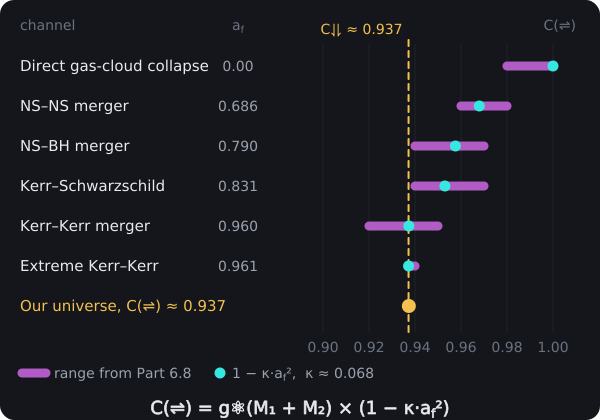
The Kerr Floor on Origin Compression. For each collision channel, the range Part 6.8 assigns (bars) against the prediction C(⇌) = 1 − κ·a_f² with κ ≈ 0.068 (dots). No merger leaves more than about 0.961, so spin cannot push compression below C⥥ ≈ 0.937, where the Extreme Kerr–Kerr range begins; our own compression sits just above it, C(⇌) ≈ 0.937 (gold).
Inherited Spin in Quanta
N↻ = J_f / ℨ↻ = 2·a_f·G·M_f² / (𝒞→·ℏ)
Dimensional analysis:
Where (from the book): N↻ [∅], J_f [𝕄·𝕃²·𝕋⁻¹]
[∅]
[𝕄·𝕃²·𝕋⁻¹] ÷ [𝕄·𝕃²·𝕋⁻¹] = [∅]
[∅] × [∅] × [𝕄⁻¹·𝕃³·𝕋⁻²] × [𝕄²] ÷ ([𝕃·𝕋⁻¹] × [𝕄·𝕃²·𝕋⁻¹]) = [∅] × [𝕄⁻¹·𝕃³·𝕋⁻²] × [𝕄²] ÷ ([𝕃·𝕋⁻¹] × [𝕄·𝕃²·𝕋⁻¹]) = [𝕄⁻¹·𝕃³·𝕋⁻²] × [𝕄²] ÷ ([𝕃·𝕋⁻¹] × [𝕄·𝕃²·𝕋⁻¹]) = [𝕄·𝕃³·𝕋⁻²] ÷ ([𝕃·𝕋⁻¹] × [𝕄·𝕃²·𝕋⁻¹]) = [𝕄·𝕃³·𝕋⁻²] ÷ [𝕄·𝕃³·𝕋⁻²] = [∅]
[∅] = [∅] = [∅] ✓ Valid PulseCore Verified ✓
Converting mechanical rotation into spin costs computational action
Where:
- N↻ [∅] — inherited angular momentum expressed in spin quanta
- J_f = a_f G M_f² / 𝒞→ [𝕄·𝕃²·𝕋⁻¹] — remnant angular momentum
- ℨ↻ = ℏ/2 [𝕄·𝕃²·𝕋⁻¹] — the spin quantum (Part 1.6, Z.11)
Worked value for a 10⁶ solar-mass remnant at a_f = 0.95: J_f ≈ 8.367×10⁵³ J·s, so N↻ ≈ 1.587×10⁸⁸ spin quanta. By the ratio of Part 1.6, Z.11 each quantum is the coordinated action of s²/2 substrate pulses, so the inheritance is written across roughly 4.423×10²¹² pulses.
➢ The count is not a pure number, and that is the point. Its dimension is inverse Complete Computational Action, the reciprocal of the residue found in Part 1.6, Z.11. Mechanical angular momentum cannot be redenominated into spin for free: every quantum of spin costs one full computational act, so the ledger only balances if the substrate spends computation to hold the inheritance. This is the formal version of the intuition that spin is not carried but processed — a direction the data is pushed, like wind, rather than a property any one pulse owns.
The Genesis Axis
n̂⇌ = n̂_f = J⊚ / |J⊚|
Dimensional analysis:
Where (from the book): n̂⇌ [∅]
Read dimensionally: n⇌ = n_f = J⊚ / (abs(J⊚))
[∅]
[∅]
[𝕄·𝕃²·𝕋⁻¹] ÷ (abs([𝕄·𝕃²·𝕋⁻¹])) = [𝕄·𝕃²·𝕋⁻¹] ÷ [𝕄·𝕃²·𝕋⁻¹] = [∅]
[∅] = [∅] = [∅] ✓ Valid PulseCore Verified ✓
The remnant's rotation axis is our Universe's preferred direction
Where:
- n̂⇌ [∅] — preferred axis of the emergent Universe
- n̂_f [∅] — remnant spin axis at coalescence
➢ Because the inheritance is a vector, it arrives with an orientation, and nothing in the genesis transition supplies a mechanism to erase it. Part 6.8 already predicted alignment of filament and void structures with the post-merger spin axis and multi-harmonic offsets in the cosmic microwave background; n̂⇌ is the axis those predictions are about. The same axis should appear in any residual large-scale anisotropy, and the several independently reported alignments in cosmic microwave background multipoles are where the framework is most exposed to being wrong. If structure is aligned with an axis at all, Binary Pulse Theory says it is the axis of the merger that made us, and there should be exactly one.
A further consequence is that spin, once inherited, is available at every level of the recursion rather than only at cosmic scale. The consequences of that for structures much smaller than galaxies are taken up later in the book.
6.9 Testable Predictions
- C(⇌) for any universe is bounded below by about 0.937; a well-measured value beneath it falsifies spin as the sole source of compression
- Our progenitor merger had a_f ≈ 0.96, two wells at the Thorne limit, since our C(⇌) ≈ 0.937 sits at the Kerr floor's edge (spin alone cannot reach below it)
- There is one preferred axis, not several, and large-scale structure alignments should share it
- Gravitational-wave catalogues constrain κ directly: remnant spins are measured, so the distribution of a_f across observed mergers predicts the distribution of C(⇌) across daughter universes
- A universe born of direct gas-cloud collapse has a_f ≈ 0 and therefore no preferred axis at all